
Rankfor.AI vs Semrush
An SEO suite with AI-visibility tracking vs a platform built only for AI answers
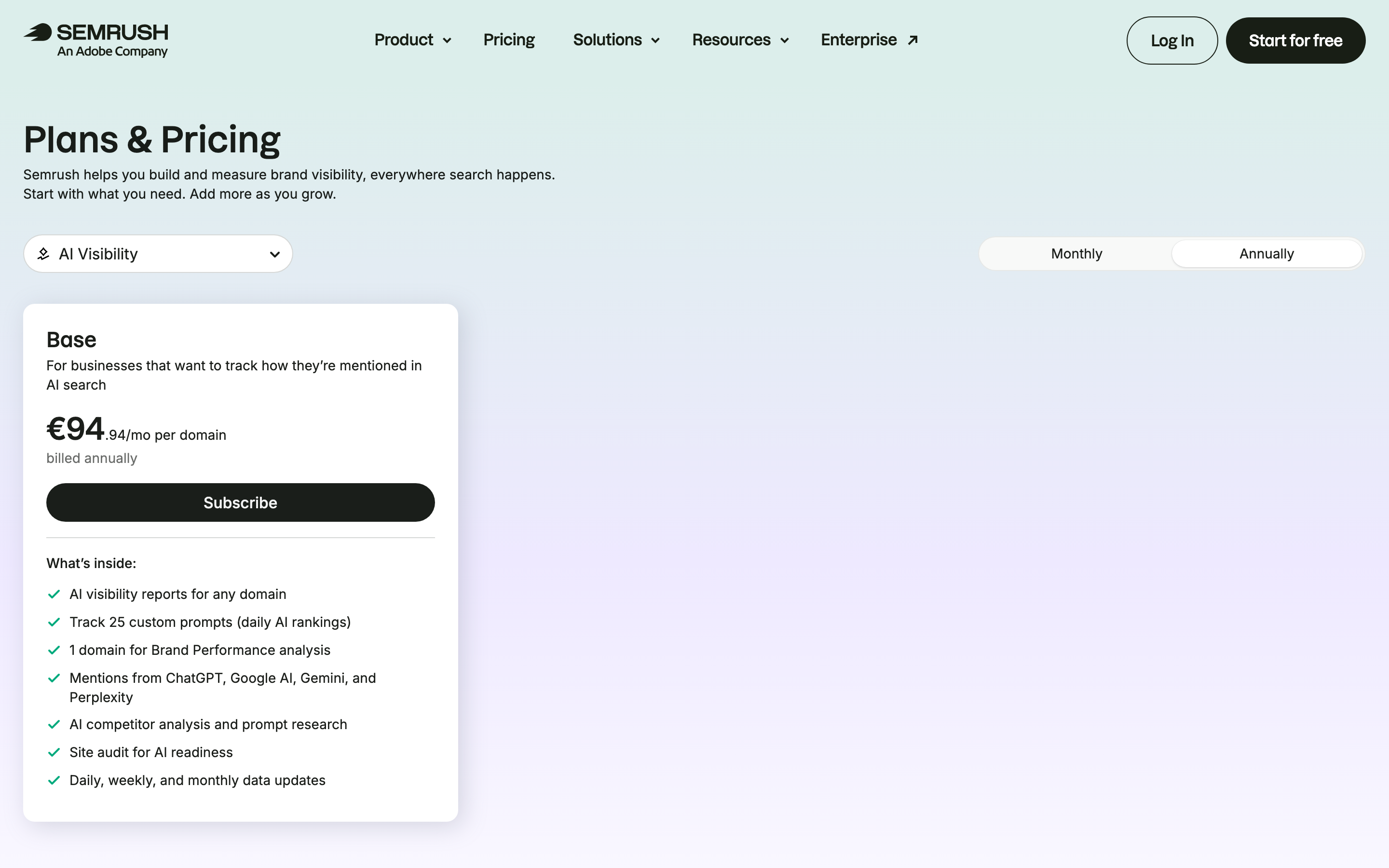
Semrush is a Boston-based SEO suite, owned by Adobe since April 2026, that sells an AI Visibility Toolkit tracking 25 prompts per domain across ChatGPT, Google AI, Gemini and Perplexity from €94.94/month. Rankfor.AI is built only for AI answers: stability-tested measurement, buyer personas, and publishing that changes what the models cite.
Choose Semrush if your team already lives in an SEO suite and wants AI-answer rankings next to keywords and backlinks, including Google AI Overviews and AI Mode. Choose Rankfor.AI when the AI answer is the decision itself: when you need to know a change is real, which buyers see it, and how to shift it.
Où les outils se positionnent
Par rigueur de mesure, et si l'outil vous aide à agir, pas seulement à rapporter. La vision de Rankfor.AI sur le paysage.






 Semrush
 Ahrefs
Différences clés
A reading you can trust, repeated
Semrush reports daily AI rankings for your tracked prompts. Rankfor.AI replays each prompt with the Dice Roll Method and reports a stability score, so a movement that is model noise is labelled as noise before anyone rewrites a page for it.
Who is asking, and in what words
Semrush prompts start from keywords and search volume. Rankfor.AI models the buyers behind the question with persona intelligence, because a CFO and a procurement lead asking about the same category get different answers.
Changes the answer as well as reporting it
Semrush recommends. Rankfor.AI publishes content to AI engines through its Feedback Loop and, on Enterprise, distributes it through media-house partners, which moves the sources the models cite.
Specialist and independent
AI visibility is one toolkit among many in Semrush, now part of Adobe Experience Cloud. Rankfor.AI does this one job, and is independent and EU-based (Tallinn and Wroclaw).
Comparaison des fonctionnalités
| Fonctionnalité | Semrush | Rankfor.AI |
|---|---|---|
| Category | SEO suite with an AI Visibility Toolkit | AI-visibility intelligence + publishing |
| AI engines tracked | ChatGPT, Google AI, Gemini, Perplexity | ChatGPT and Gemini on every plan; Claude, Grok, Perplexity, Mistral on Enterprise |
| Google AI Overviews and AI Mode | Yes | Non |
| Prompts on the entry plan | 25 per domain (AI Visibility Base) | Set per project |
| Stability / variance method | Daily rankings | Dice Roll stability score |
| Who is asking (personas) | Keyword and search-volume prompts | Persona intelligence + coverage |
| Brand DNA / territory map | Non | 2D + 3D territory map |
| Keyword research, backlinks, site audit | Yes, the core of the product | Non |
| Publish to AI engines | Non | Feedback Loop content + crawler analytics |
| Off-site media-house distribution | Non | Managed, Enterprise |
| Ownership | Adobe (since April 2026) | Independent, EU |
Méthodologie : Comment chaque outil fonctionne
Semrush
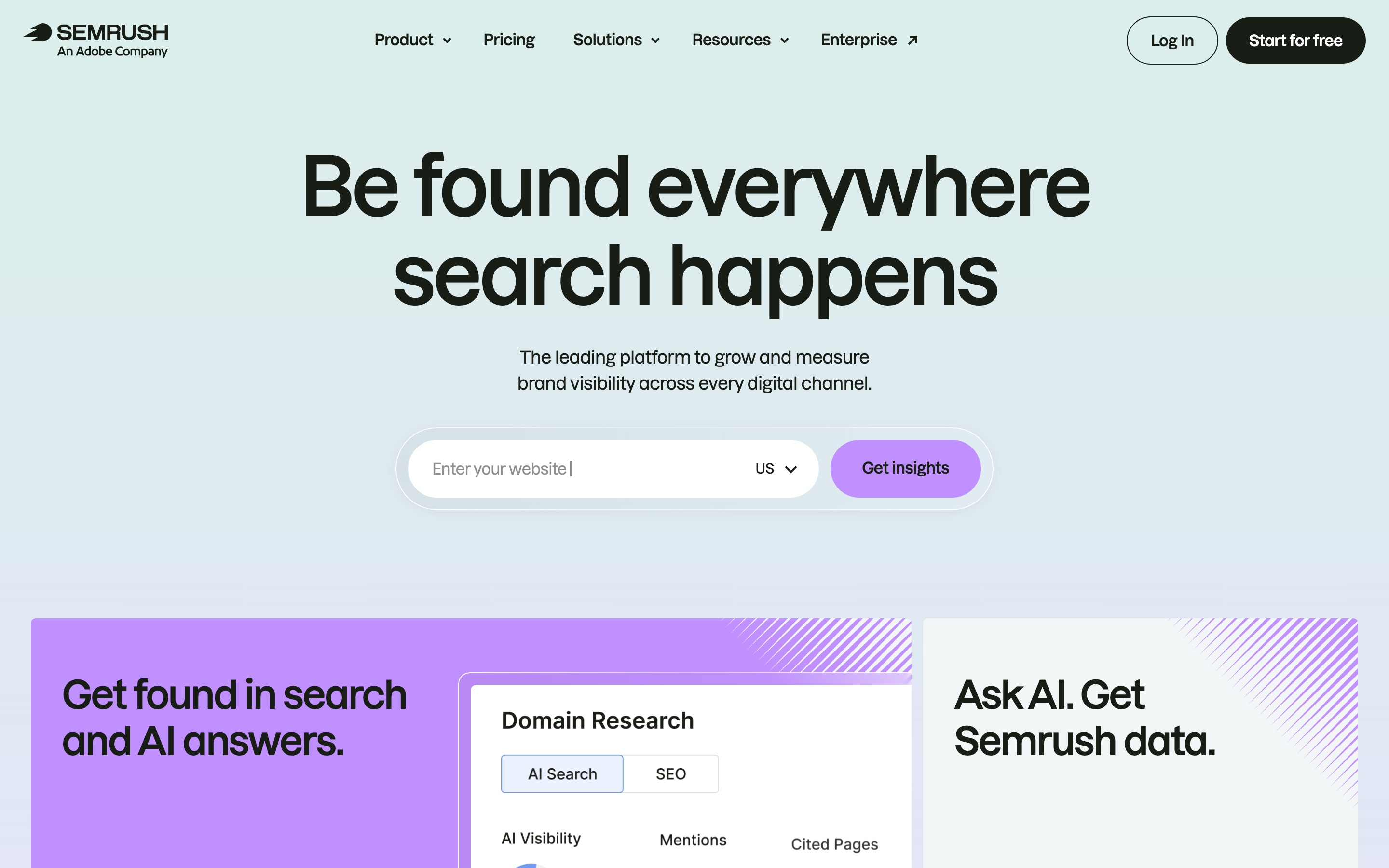
Be found everywhere search happens
Semrush tracks a list of prompts you define, 25 per domain on the AI Visibility Base plan and 50 to 200 on the SEO + AI plans, and reports daily where the brand is mentioned and cited across ChatGPT, Google AI, Gemini and Perplexity. The results sit beside its keyword, backlink and site-audit data, and it recommends changes to make.
Rankfor.AI
Intelligence de visibilité IA
Rankfor.AI replays prompts with the Dice Roll Method so each reading carries a stability score, models the buyers asking through persona intelligence, maps brand territory, and closes the loop by publishing content to AI engines and, on Enterprise, distributing it through media-house partners.
Pourquoi la méthodologie est-elle importante ?
AI answers vary between runs. A daily ranking without a stability measure cannot tell a real shift from noise, and a team that reacts to noise spends a quarter fixing nothing. Measuring the variance first, then acting on the sources, is where the two products part.
Comparaison des tarifs
Semrush
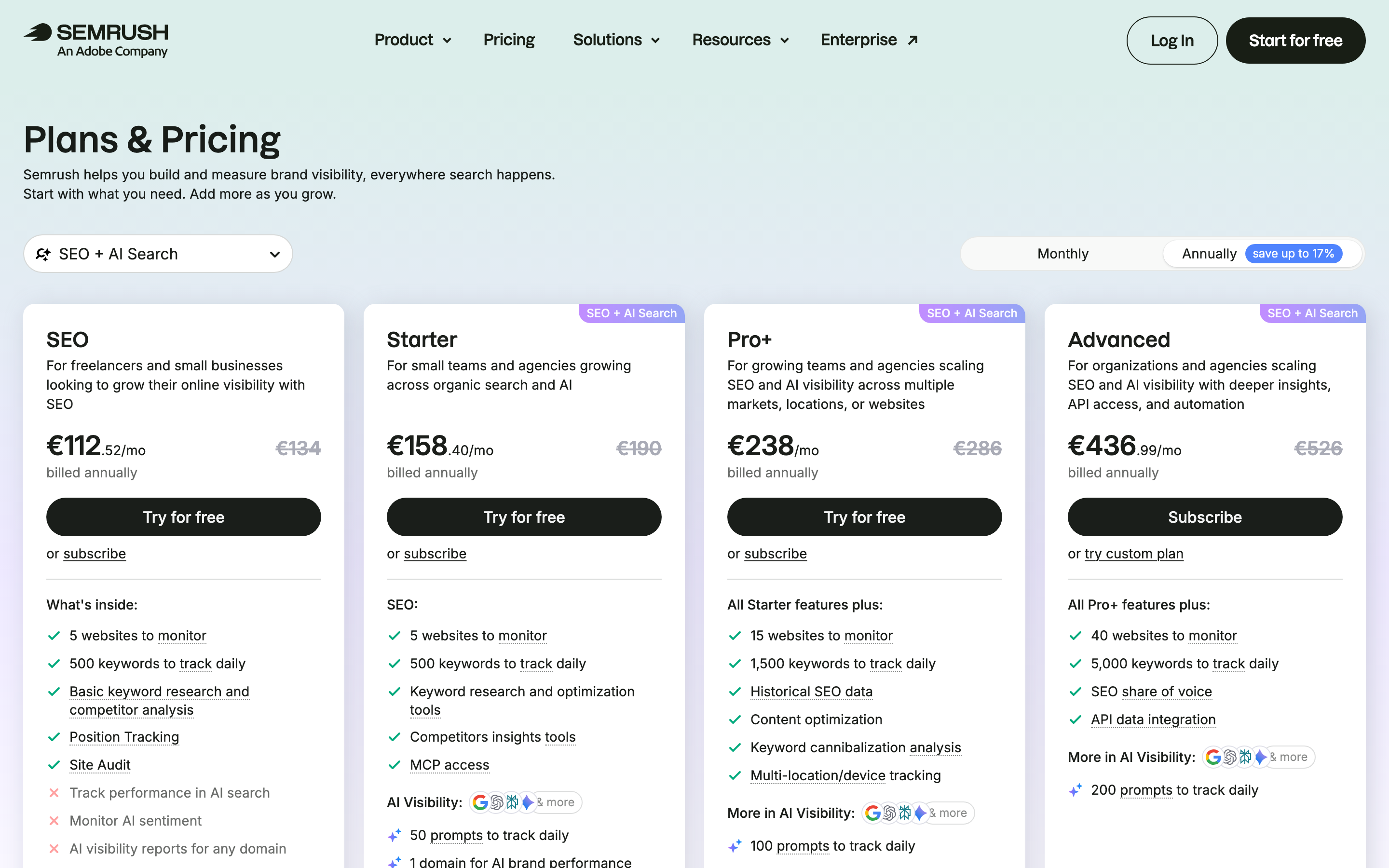
- 25 tracked prompts, daily AI rankings
- ChatGPT, Google AI, Gemini, Perplexity
- 1 domain for Brand Performance
- Billed annually
- 5 websites
- 500 keywords tracked daily
- 50 prompts tracked daily
- Billed annually
- 15 websites
- 1,500 keywords tracked daily
- 100 prompts tracked daily
- Billed annually
- 40 websites
- 5,000 keywords tracked daily
- 200 prompts tracked daily
- API access
Rankfor.AI
- For teams shaping how AI describes them
- Rankfor® Index + 4-pillar AI Visibility Score
- Persona intelligence + AI content plans
- Scans ChatGPT, Gemini and Grok
- 1 seat, 1 project (upgrades available)
- Billed annually
- Everything in Marketer, plus:
- Dice Roller stability testing
- Discovery Lab + Answer Trail
- Competitive intelligence + Brand DNA Map
- 3 seats, 3 projects (upgrades available)
- Billed annually
- Everything in Strategist, plus:
- Claude coverage + extra markets and languages
- Feedback Loop: publish to AI engines + crawler analytics
- Off-site media-house distribution (managed)
- Custom seats, projects, SSO and integrations
Quel outil vous convient le mieux ?
Choisissez Semrush si vous avez besoin de :
- SEO teams that want AI rankings inside the suite they already use
- Tracking Google AI Overviews and AI Mode alongside organic search
- Buyers who need keyword, backlink and audit data in one contract
- Adobe Experience Cloud customers
Choisissez Rankfor.AI si vous avez besoin de :
- Teams that need to know an AI-visibility change is real
- Marketers who need to see which buyer personas get which answer
- Brands that want to change the answer, and earn off-site citations
- EU buyers who prefer an independent specialist
À propos de Semrush
- Localisation :
- Boston, USA
- Fondée :
- 2008
- Financement :
- Acquired by Adobe on 28 April 2026 for about $1.9B; previously listed on the NYSE (SEMR). Owns Brand24 through Prowly.
- Site web :
- semrush.com
À propos de Rankfor.AI
- Localisation :
- Tallinn, Estonie + Wroclaw, Pologne
- Fondée :
- 2025
- Financement :
- Pré-amorçage, Simpact Ventures
- Site web :
- rankfor.ai
Autres questions posées
Recherches associées
L'état de l'AI Visibility : pourquoi les marques perdent le contrôle dans les réponses de l'IA
La recherche existe toujours, mais elle a cessé d'être l'endroit où les décisions se prennent. Le SEO traditionnel supposait que si vous étiez bien classé, vous seriez découvert. L'IA ne fonctionne pas ainsi. Cet article de fond explique pourquoi la visibilité IA est importante et présente ses quatre dimensions : la présence, la pertinence, l'utilité et la confiance.
Le piège du « Best Of » : pourquoi les listes auto-promotionnelles perdent sur Google et gagnent sur ChatGPT
Trois signaux en une semaine : Google a pénalisé les listes auto-promotionnelles (les marques SaaS perdant de 34 à 49 % de leur visibilité) et a réduit ses limites d'exploration de 86,7 %, tandis qu'Ahrefs a révélé que 44 % des citations de ChatGPT proviennent de ces mêmes listes. Google se contracte, l'IA s'étend. Ce document propose une méthode d'audit de marque en 5 minutes et une stratégie scindée pour naviguer au sein de ces deux systèmes de découverte.
Comment vendre la visibilité IA à vos clients : un guide pour les agences
Ce document se concentre exclusivement sur la conclusion de contrats de vente. Découvrez la méthode en 4 étapes pour vendre des services de visibilité IA : analyser le site web du client, lancer une analyse Rankfor.AI, évaluer les personas ainsi que les territoires sémantiques, et conclure par des questions stratégiques.
Prêt à découvrir ce que l'IA pense réellement de votre marque ?
Essayez nos outils gratuits de visibilité IA, aucune inscription requise.