
A buyer asks an AI assistant which companies in a sector are worth a look, and gets a list. Most checks of AI visibility ask for a top ten and record whether a brand is on it. We wanted to know what a top ten leaves out.
We took 45 fast-growing European firms and asked Gemini 3.1 Pro about their sectors and countries three ways, changing one sentence: name up to ten companies, name up to twenty, or name as many as you can.
Disclosure. Rankfor.AI sells AI visibility audits and a managed service. Neither test was commissioned or paid for by any company it measured. The 45 firms come from the FT 1000 ranking of Europe's fastest-growing companies. We report totals only and name no firm.
The short answer
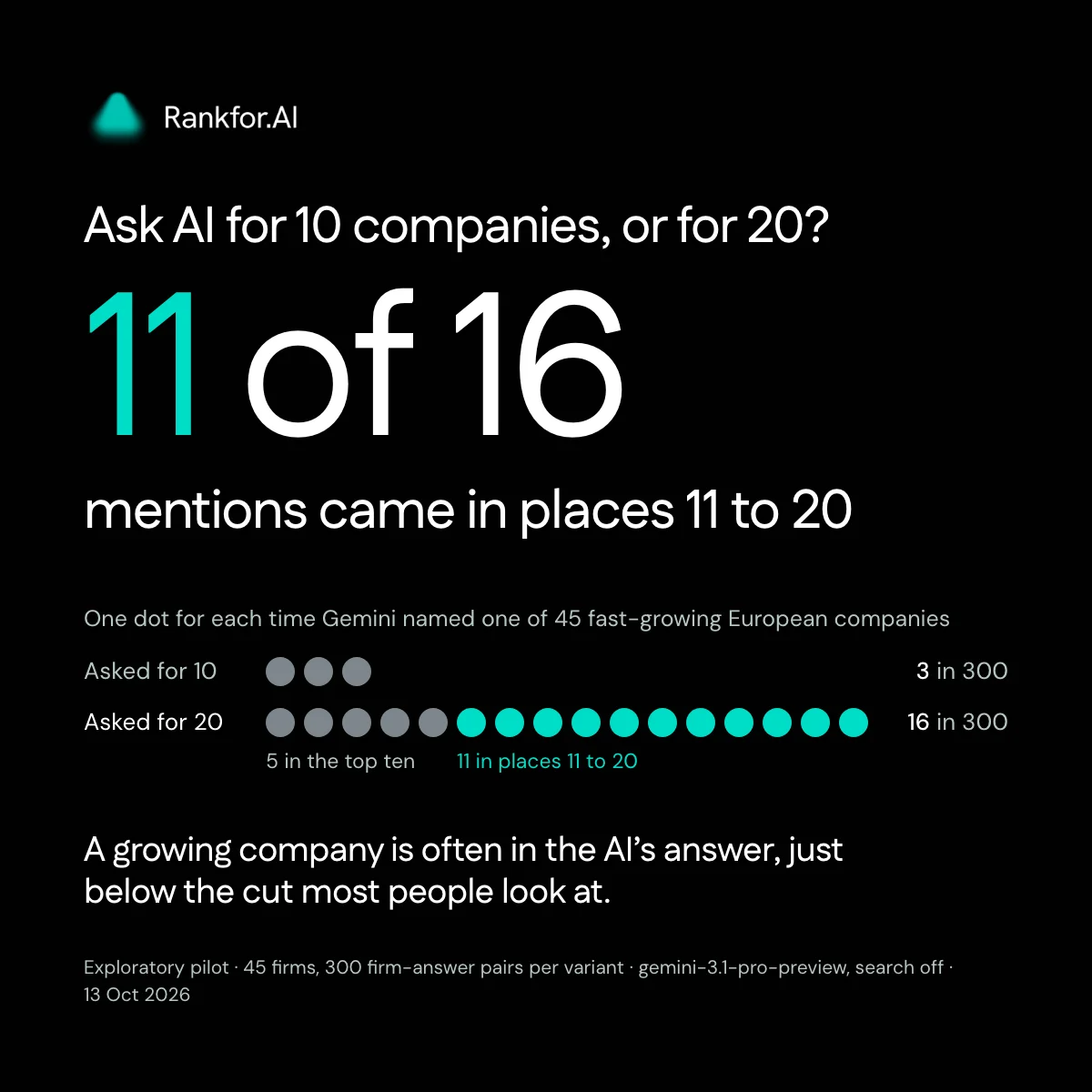
- Asked for up to ten companies, Gemini named one of the 45 firms in 3 of 300 chances (1.0%).
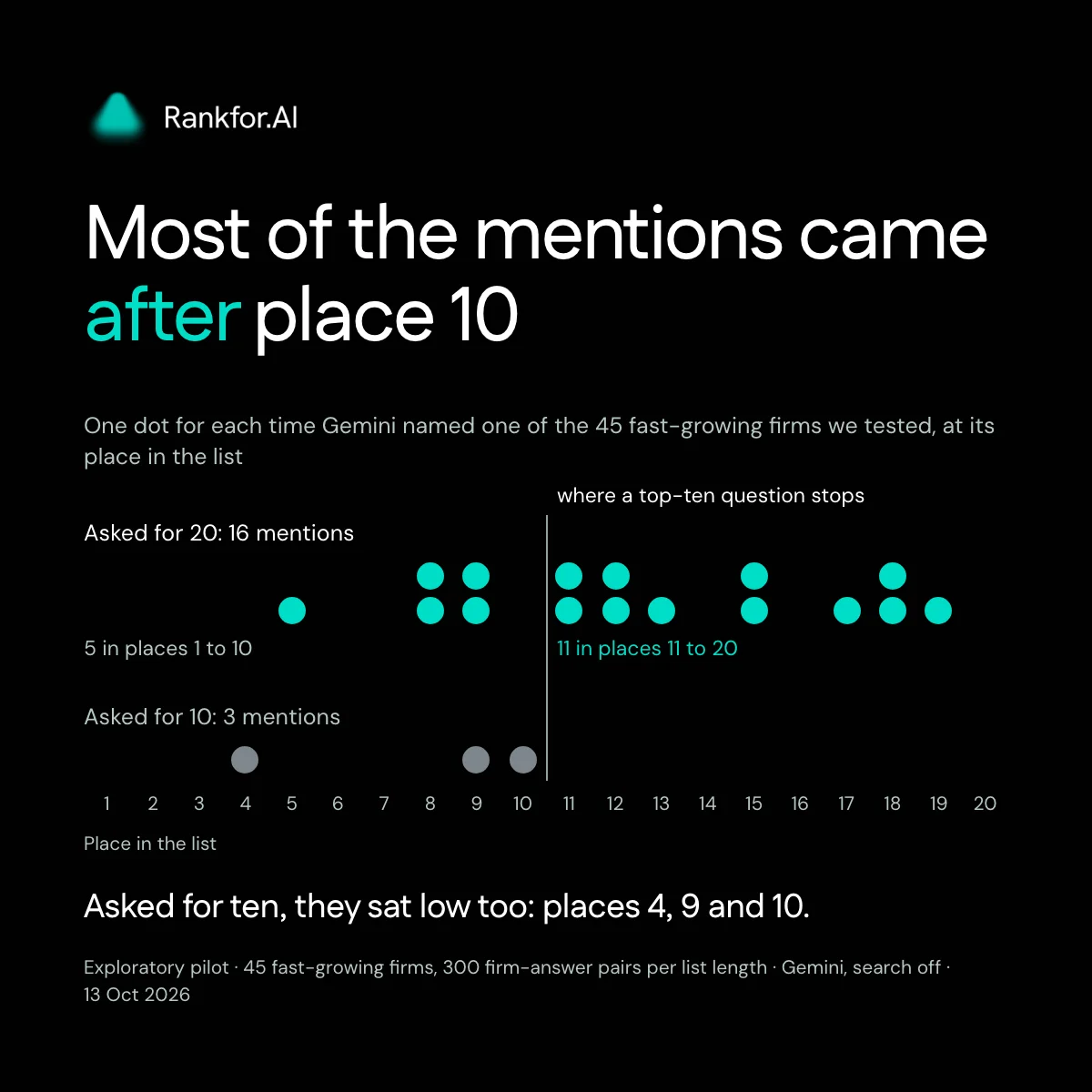
- Asked for up to twenty, it named one in 16 of 300 (5.3%). 11 of the 16 mentions sat at positions 11 to 19.
- Asked for as many as it could name, 7 of 300 (2.3%). The answers averaged about 15 companies.
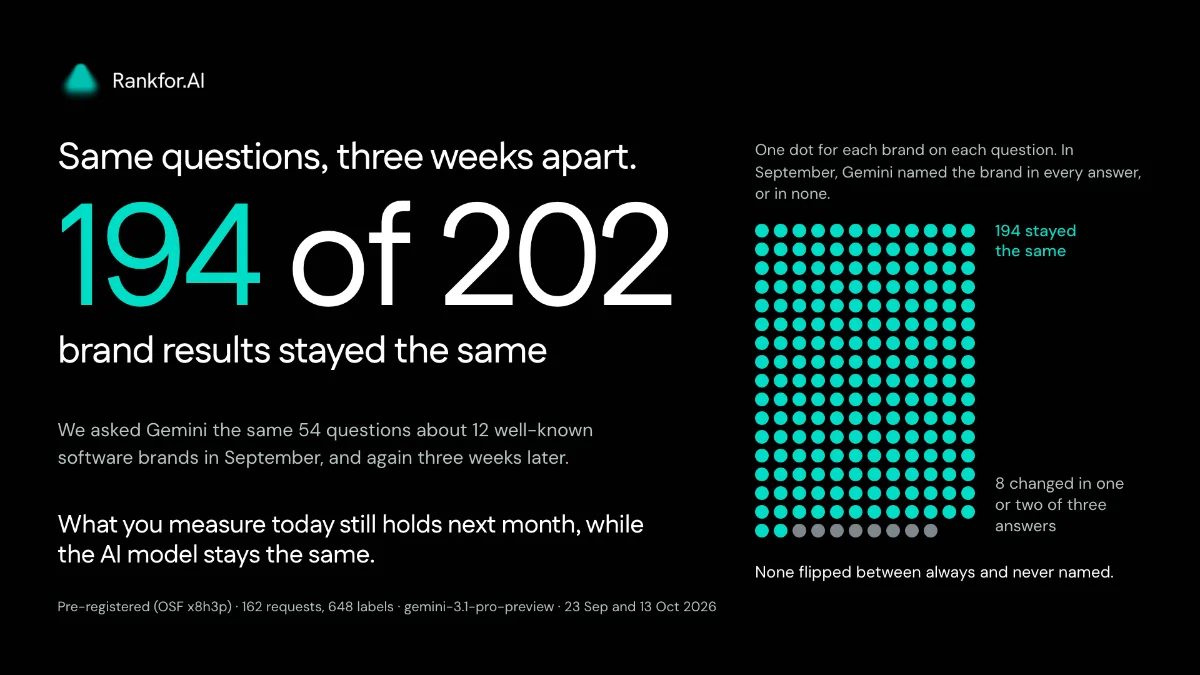
- In a separate, pre-registered test, answers about 12 software brands held for 20 days. Of 202 brand-and-question pairs that were all-or-nothing in the last September session, 194 were unchanged in October and none reversed.
The top ten is where the cut happens
The model fills the length it is asked for. 99% of the ten-item answers listed exactly ten companies and 90% of the twenty-item answers listed twenty; every twenty-item answer listed at least fifteen.
The firms we tested sit mostly in the second half of those longer lists. With twenty items, the 16 mentions came at an average position of 12.5, and 11 of them came after position 10. Five came in the top ten. Cut each twenty-item answer at ten, and it would have named a pilot firm 5 times in 300, close to the 3 times that the ten-item answers did.
So the model can name more of these firms than a top ten shows. Most of its mentions of them fall below the cut. With twenty items, 7 of the 45 firms were named at least once. With ten, 3 were.
"As many as you can" does not fix it
An open request sounds like the obvious answer. It gave shorter lists than asking for twenty: 15.2 companies on average, with 61% of answers reaching fifteen and 8% reaching twenty. The pilot firms were named in 7 of 300 chances, 4 of them after position 10, none later than position 15.
Asking for twenty gets the model further down its list than asking for everything.
How we ran the list-length test
The 45 firms were last listed in the 2024 edition (28 firms) or the 2025 edition (17) of the FT 1000, and are absent from the edition our next study uses. They fall into 16 sector-and-country cells in 9 countries.
Each cell got three questions, with the sector and country filled in and no company named:
- Which companies in the sector have their head office in the country?
- Apart from the largest and best-known names, which companies in the sector and country are worth knowing?
- A customer is looking for a company in the sector and country. Which companies would you recommend?
Every cell was asked in English, and 2 cells also in their national language. Each question ran twice, which gives 108 calls per version and 300 chances for a firm to be named (a firm and an answer to a question about its cell). The model was gemini-3.1-pro-preview with web search off, on 13 October 2026. Only the list-length sentence changed between versions.
A firm counts as named when its name or a listed alias appears as a whole word in the answer. Intervals come from resampling firms, 95%: 0.0% to 2.2% for ten items, 1.7% to 9.9% for twenty, 0.7% to 4.6% for an open list. The pilot was sized to choose a design, so the intervals for ten and twenty overlap slightly; where the 16 mentions sat in the list is the clearer evidence.
We ran it to design a larger study of firms AI rarely names. At the ten-item rate, that study would see about 19 English-language mentions in each of its two parts, against the 50 it needs; at the twenty-item rate, about 102. Its questions now ask for up to twenty companies. The longer answers cost more: USD 0.026 per call against USD 0.017.
The answers held for three weeks
A finding about list position is only worth acting on if answers do not reshuffle from week to week. A separate study, run with a plan registered in advance, tested whether answers about known brands reshuffle.
We sent Gemini 3.1 Pro 54 questions about software for small companies in Estonia and Finland, in English, Estonian and Finnish, each asking for up to five products. Each question had four candidate brands from one of three categories: e-commerce platforms, project management and sales CRM. We asked every question three times in each of three sessions on 22 and 23 September 2026, and sent the identical requests again on 13 October, 20 days later. Before the first October call, the plan and its pass rule were frozen and registered on OSF.
- The September answers predicted the October ones almost as well as the first two sessions had predicted the third, 8 hours later. The forecast error (Brier score, where 0 is perfect and 0.25 is a coin toss) was 0.0281, against 0.0259 at 8 hours. The registered pass line was 0.0559.
- The September forecast beat a brand-level average in all nine question groups.
- Of 202 brand-and-question pairs that were all-or-nothing in the last September session, 194 were identical in October. None went from always named to never named, or back.
- Every answer reported the same model version, and none searched the web.
- The most recent September session alone predicted October nearly as well as all three sessions together (0.0292 against 0.0281).
The stability shows is that, for this model, the brands named in answers to a fixed question did not drift over three weeks. That makes one careful measurement of whether a brand is named worth acting on.
What a marketing team can do with this
- Ask for twenty and record the position. A top-ten check tells you whether you are in the top ten. Asking for twenty also shows positions 11 to 20.
- Read a zero in a top ten as "not in the top ten". Check positions 11 to 20 before you conclude that AI does not know your company.
- Ask each question three times. In the stability test, three answers per question from one session predicted answers 20 days later almost as well as nine answers from three sessions.
- Measure again when the model changes. Record the model version each answer reports. With an unchanged version, our answers held for three weeks; a new version is the moment to look again.
- Note whether the answer searched the web. No answer in either test did. Answers that search can behave differently.
Method and limits
- Model: gemini-3.1-pro-preview through Google's programming interface. Consumer apps can answer differently.
- List-length pilot: 45 firms from the 2024 and 2025 editions of the FT 1000, 16 sector-and-country cells in 9 countries, three questions per cell, two repeats, 108 calls per version, search off, 13 October 2026. Exploratory: run to choose the design of a later pre-registered study, and not registered itself. The three versions ran one after another on the same day.
- Stability test: 54 questions, 12 software brands, three languages, two requested markets, three repeats per session; three sessions on 22 and 23 September 2026 and one on 13 October 2026; 648 brand labels per session. Pre-registered on OSF with a pass rule fixed before the first call.
- Reading the answers: a brand or firm counts as named when its name or a listed alias appears as a whole word. Both tests use automatic labels; a blind human check of 96 stability-test labels is reported in the research note.
- Limits: one model and one provider. The pilot is small: 45 firms, 300 chances per version, and some cells hold only a few firms. The stability test covers one interval of 20 days and 12 software brands, so it gives no rate of change over longer periods. Neither test measures whether an answer recommends a company, its tone, or the accuracy of what it says.
Aggregate numbers of the pilot are available on request: research@rankfor.ai.
BeVisible Club
Get research like this before we publish it.
New AI visibility studies, ranking patterns, and source-stack data delivered to your inbox a week before they go public.
Join BeVisible ClubWant to Know How AI Sees Your Brand?
Rankfor.AI measures your brand's AI visibility across all major platforms and provides actionable recommendations.
About the Author

Founder & CEO
Dmitrij Żatuchin is the founder of Rankfor.AI. A computer scientist with a PhD in semantic web technologies, he bridges the gap between how AI reasons about brands and how brands want to be understood. With over two decades of software architecture experience and academic roles at Estonian Business School, Dmitrij builds the measurement infrastructure brands need to transition from optimizing for search engines to becoming visible for reasoning engines.