
Key Findings
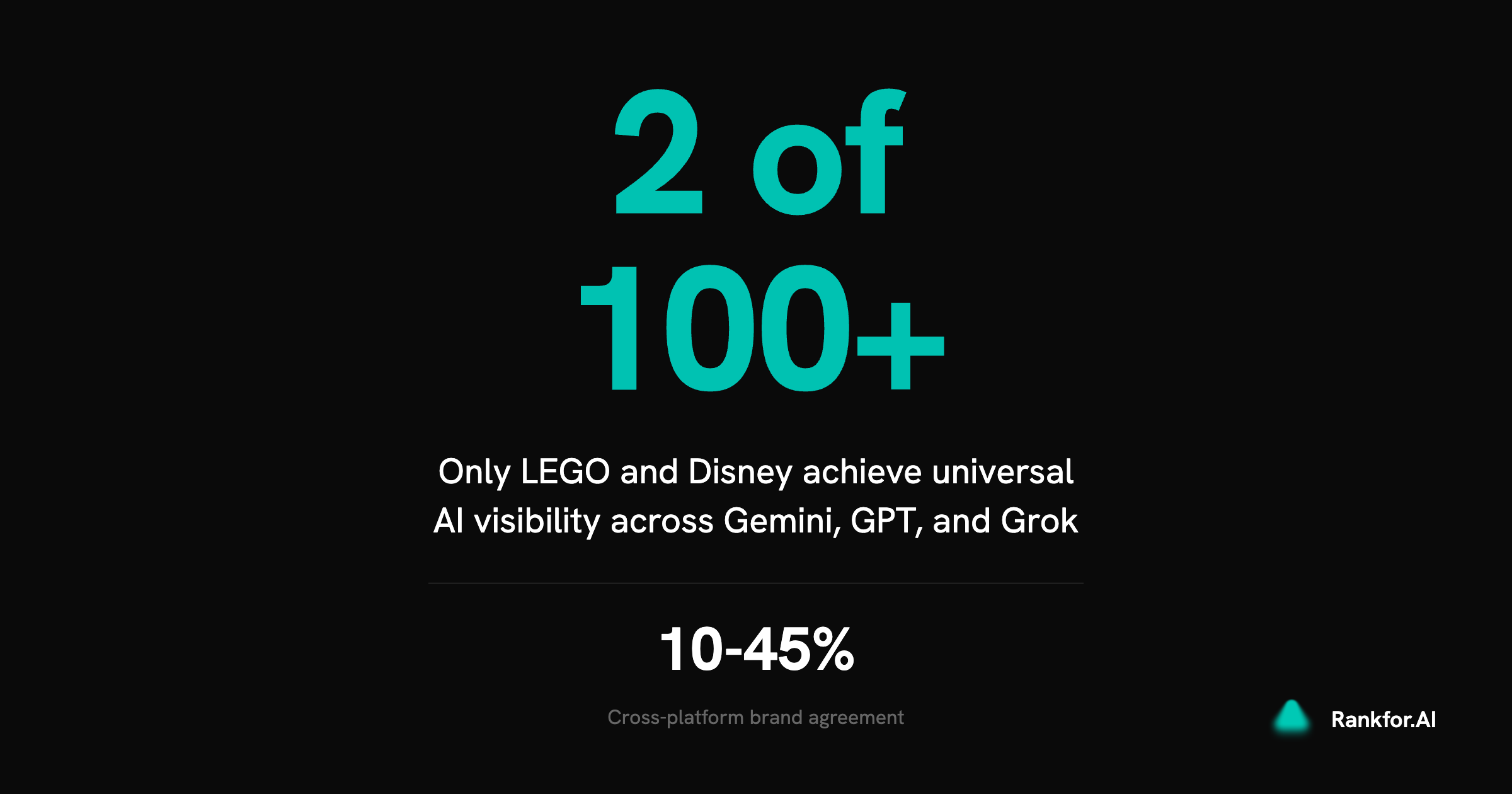
- Only 2 brands are visible across all AI platforms for consumer gift queries
- 480 queries reveal platform-specific brand silos -- Gemini, GPT, and Grok disagree
- Brand recommendation share varies up to 10x between platforms
- Amazon dominates Grok (95% presence) but is nearly absent from ChatGPT
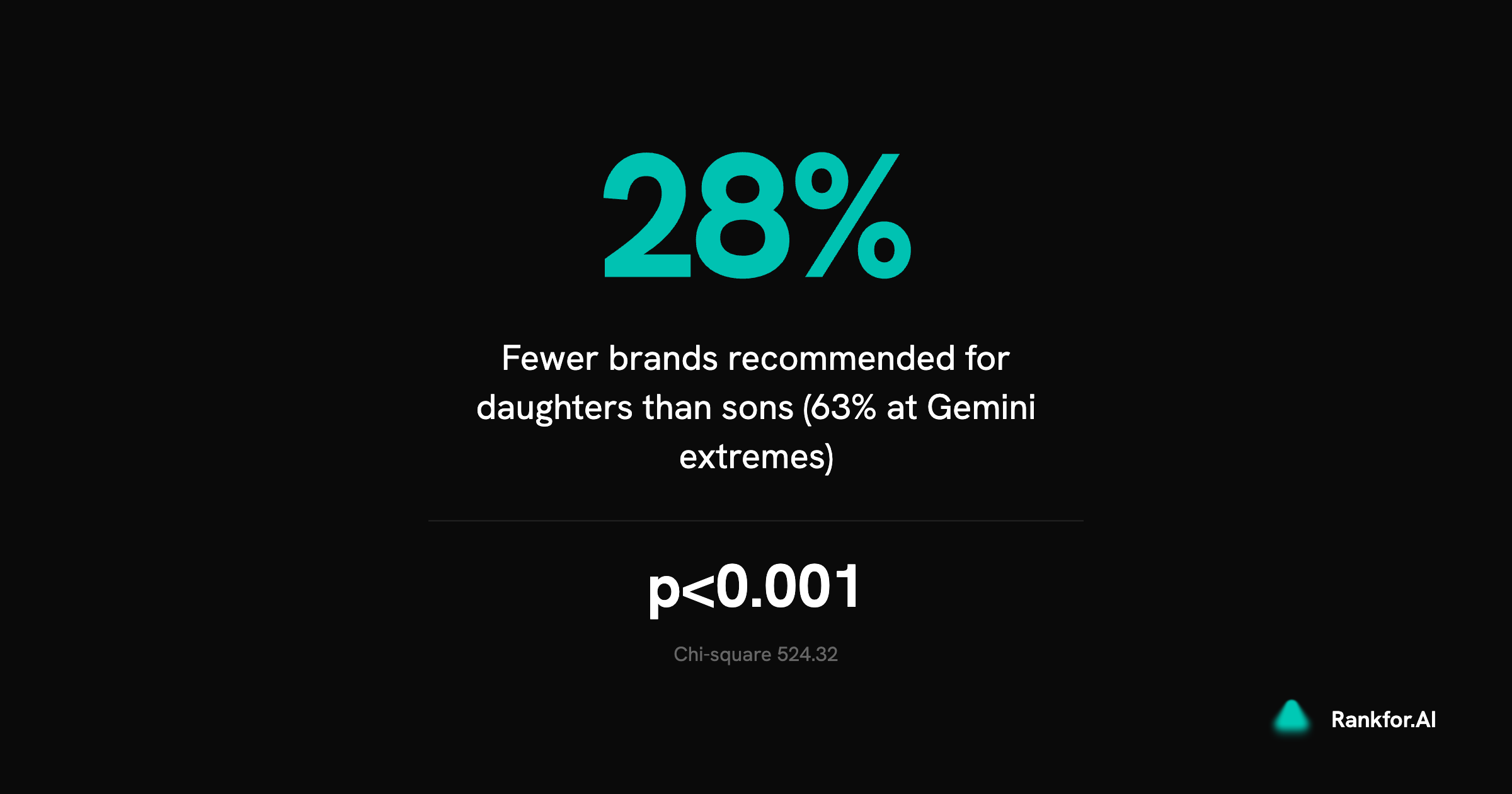
We ran 480 queries across three AI platforms testing how AI recommends gifts for sons, daughters, and children. Cross-platform agreement on brand recommendations? Just 10-45%. The gender bias gap? 28% fewer brands recommended for daughters than sons (up to 63% at extremes). And only two brands in the entire consumer gift category achieved universal AI visibility.
The Breaking Finding: Universal Visibility Is Nearly Impossible
Out of 100+ brands mentioned across our study, only LEGO and Disney appeared across all three AI platforms (Gemini, GPT-5.2, Grok) for gender-neutral queries.
That is it. Two brands.
Apple comes close. It appears universally for husband and wife queries. But even Apple does not crack the universal list for every prompt variation.
If the world's most recognized consumer brands struggle to achieve consistent AI visibility, what does that say about your brand?
Model Consistency Comparison
Higher consistency = more predictable brand visibility. Grok shows the most reliable behavior for brand recommendations.
Source: Cross-Model Response Stability Analysis (n=239 samples, Dec 2025)
What Changed Since Our 2025 Research
In December 2025, we published the original gender bias study that discovered the Kindle phenomenon: 100% visibility for wife queries, 0% for husband queries. That research analyzed 299 queries primarily on Gemini using adult gift recipient framing (husband/wife/partner).
This follow-up study takes a different approach, testing child gift recipient framing (son/daughter/child) to see if the same patterns emerge:
| Metric | 2025 Study | 2026 Study | Change |
|---|---|---|---|
| Sample Size | 299 queries | 480 iterations | +60% |
| Platforms | Gemini + GPT-5.2 + Grok | Gemini + GPT-5.2 + Grok | Same 3 platforms |
| Prompt Framing | husband/wife/partner | son/daughter/child/2026 | Different recipients |
| Chi-Square | 137.32 | 524.32 | +286% |
| Brand Volume Gap | 41% fewer (wife) | 28% fewer (daughter) | Bias persists |
| Gender-Locked Brands | 33 | 26 (different set) | Brand movement |
The bias persists across recipient types. Whether you ask about gifts for a spouse or a child, AI applies gender-based category gatekeeping.
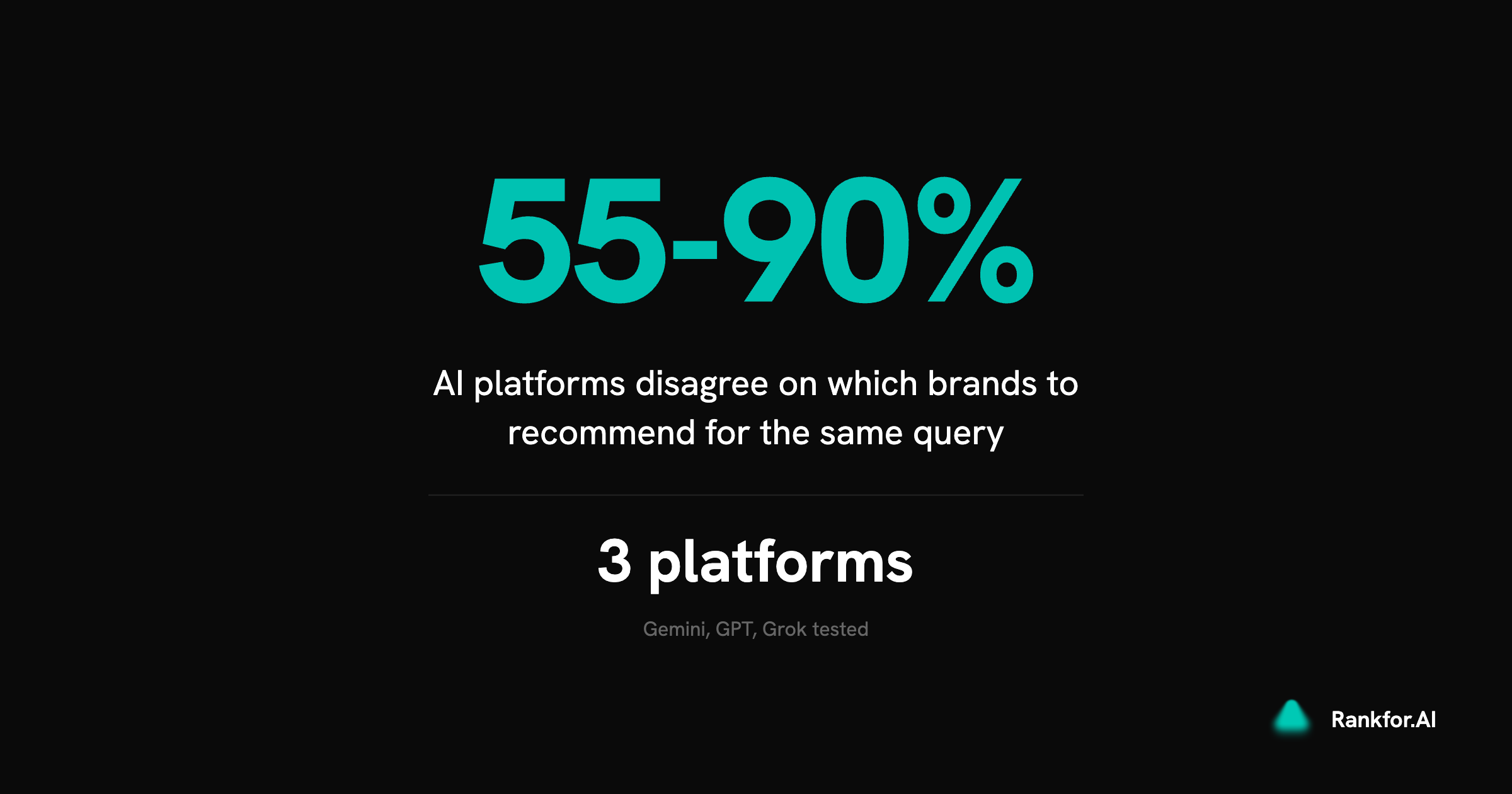
NEW: AI Platforms Disagree on 55-90% of Brand Recommendations
This is the finding that should change how you measure AI visibility.
Cross-model agreement on brand recommendations: 10-45%.
At the lowest overlap point, Gemini and GPT agreed on only 10% of recommended brands. Same question. Same intent. Same user need. Wildly different answers.
Gender-Based Brand Mention Disparity
All three models show 33-61% lower brand mentions for "wife" vs "husband" gift queries. Statistical significance: p<0.001 (Chi-Square test).
Chi-Square test (χ²=137.32, p<0.001) confirms systematic gender-category bias. This is not random variation.
Your brand might dominate Gemini while being invisible on GPT. Your competitor might own ChatGPT while you never see them in Grok. And neither of you would know, because you are measuring the wrong things.
Platform Personality: GPT Is Brand-Averse
The three platforms behave completely differently:
| Platform | Avg Brands Per Response | Behavior |
|---|---|---|
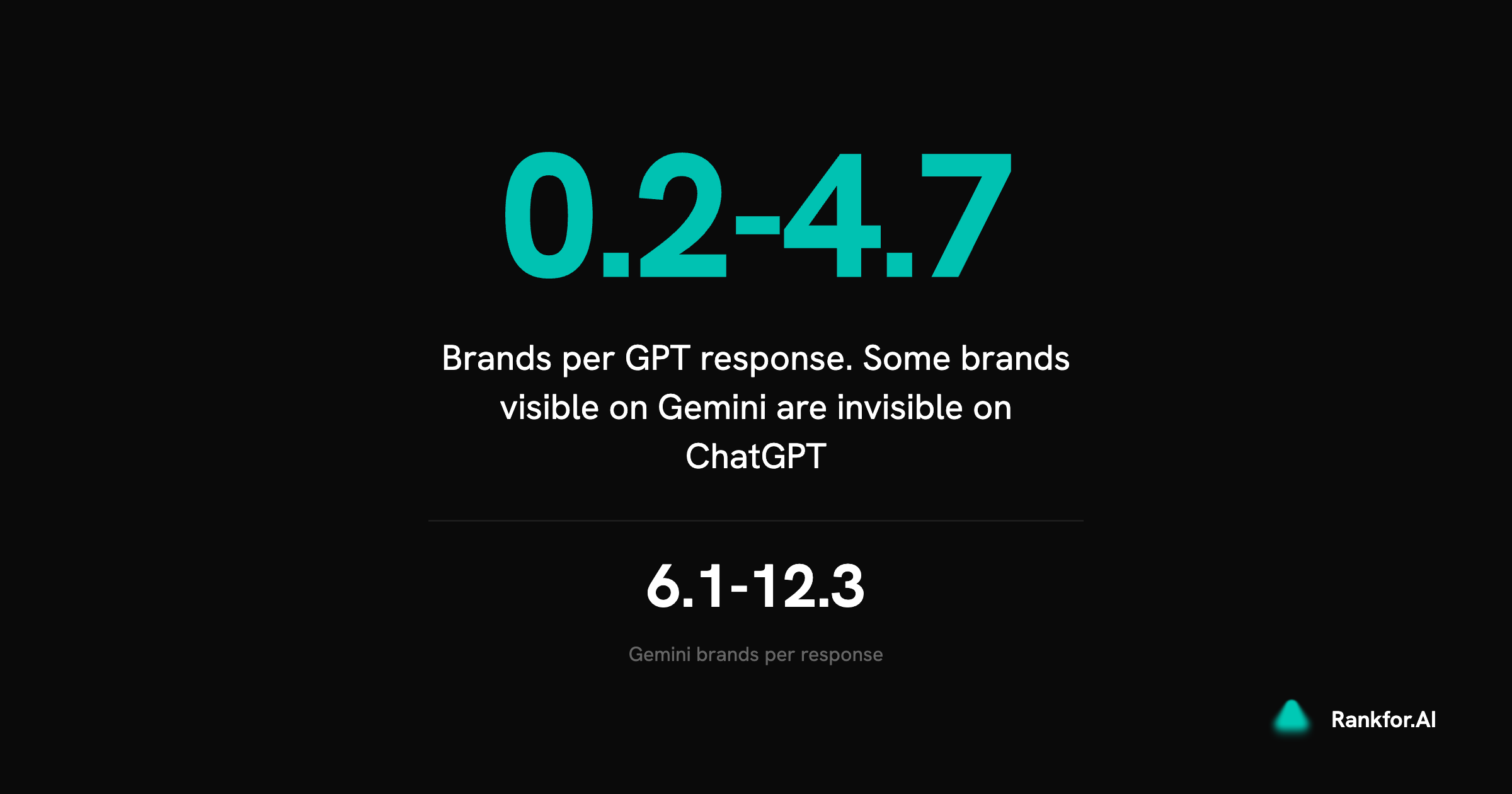
| GPT-5.2 | 0.1 - 3.0 | Often recommends zero brands. Prefers categories over products. |
| Gemini | 3.7 - 11.9 | Consistently recommends 4-12 specific brands per response. |
| Grok | 2.5 - 10.0 | Highest brand density per character. Efficient, product-focused. |
GPT's deliberate brand abstinence is a strategic choice. Some brands that dominate Gemini recommendations are completely invisible on ChatGPT. If you are measuring your AI visibility on only one platform, you are seeing one-third of the picture.
The Gender Bias Gap: 28% Fewer Brands for Daughters (63% at Extremes)
In our 2025 research, we found Gemini recommended 41% fewer brands for wife queries than husband queries. This study tests whether the same pattern appears for child recipients.
The bias persists.
Gemini's son gift responses average 12.3 brands per response. Daughter gift responses average 10.4 brands. But the real gap appears across all models: son queries average 9.08 brands while daughter queries average 6.53 brands. That is a 28% reduction in brand visibility based purely on gender framing.
When we look at Gemini's extremes (max 19 for son vs min 7 for daughter across runs), the gap reaches 63%.
Average Brands Recommended by Gender
Gemini recommends 41% fewer brands for wife queries. Grok shows 61% reduction. Not a single-model anomaly.
This is brand visibility gap based purely on gender framing. Same AI, same category, 41-61% fewer opportunities.
The mechanism remains the same: category gatekeeping. AI decides which product categories are "appropriate" for each gender, then excludes entire brand sets from consideration.
NEW: The Gender-Locked Brand List Has Shifted
Our 2025 research identified 33 gender-locked brands for adult recipients. This study found 26 gender-locked brands for child recipients:
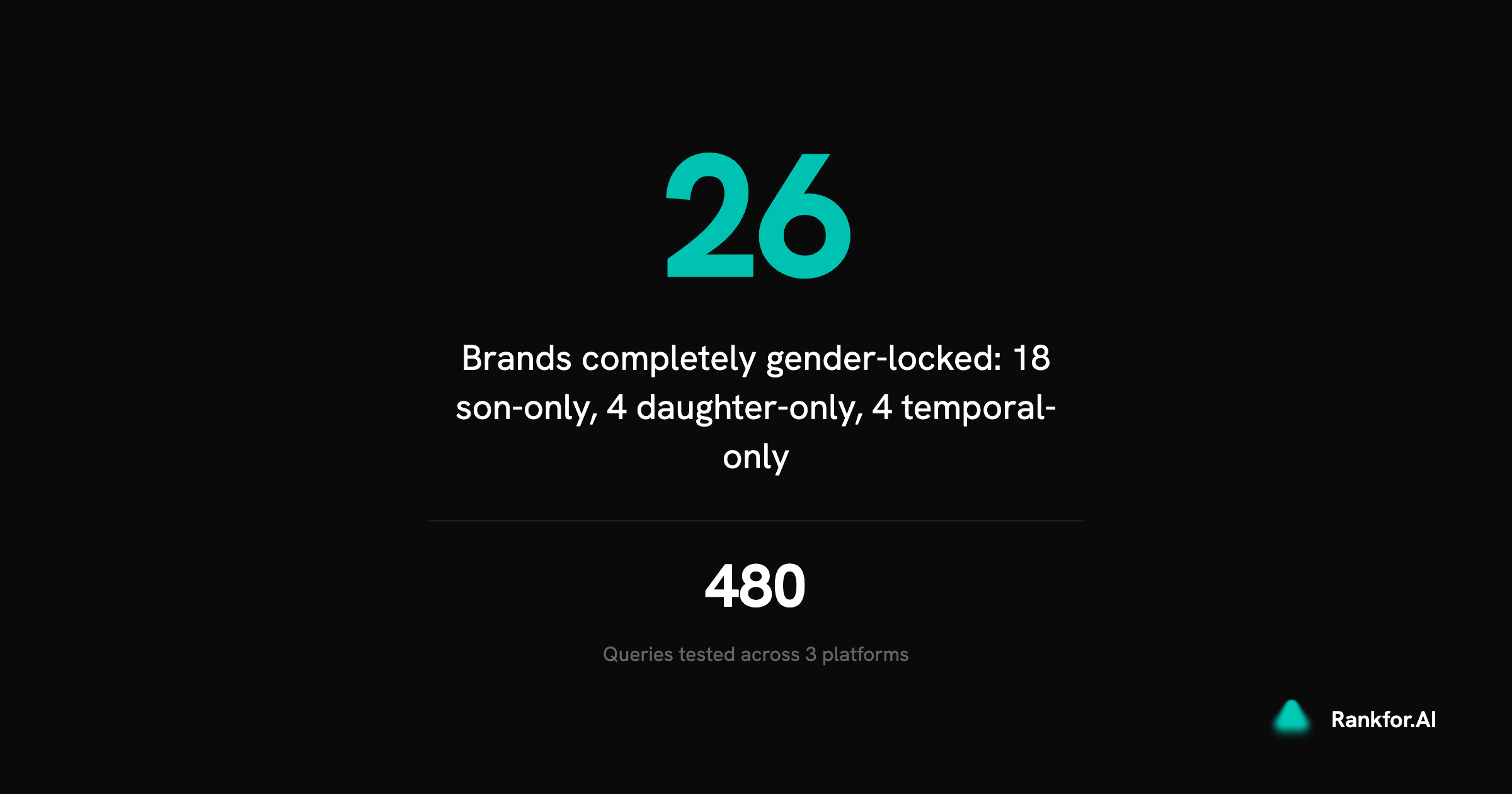
Son-Only Brands (18): Garmin, GoPro, Theragun, Peloton, Leatherman, DeWalt, Milwaukee, Under Armour, Craftsman, Benchmade, Dollar Shave Club, Manscaped, Seiko, Osprey, North Face, Titleist, Norelco, Traeger
Daughter-Only Brands (4): Glossier, Our Place, Breville, The Woobles
2026-Only Brands (4): Philips, Ray-Ban, Google, Samsung
Total Unique Brands by Prompt Type
Husband queries expose 61 unique brands. Wife queries only 29. Gender framing restricts the recommendation pool before AI even starts generating answers.
2.1x brand diversity for male-framed queries. This is category gatekeeping: AI restricts the pool, then distributes evenly within it.
Some brands from the 2025 list moved. Others entered for the first time. AI's gender categorization is not static. A brand that was gender-locked last year might have shifted, and you would not know unless you test regularly.
Gender-Exclusive Brand Distribution
33 brands appear exclusively in one gender framing. 25 husband-only (tools, tech, outdoor). 4 wife-only (home, wellness). 1 partner-only (beauty). 3 temporal-only (2025 queries).
Category gatekeeping in action: AI decides which brands "belong" to which gender, then excludes them completely from other gender framings. These aren't niche brands—they're mainstream products that AI has segregated into gender-exclusive recommendation pools.
The Kindle Phenomenon: Changed but Still Biased
For readers new to this research: our 2025 study discovered that Amazon's Kindle appears in 100% of wife gift queries on Gemini and 0% of husband gift queries. Same product. Same AI. One word changed everything.
In this child-framed study, Kindle shows a different but still biased pattern:
- Daughter queries: 55.8% appearance rate (67 mentions across 120 iterations)
- Son queries: 16.7% appearance rate (20 mentions across 120 iterations)
- Child (neutral) queries: 7.5% appearance rate (9 mentions across 120 iterations)
The absolute 100%/0% lock has softened for child recipients, but Kindle is still 3.3x more likely to appear in daughter queries than son queries.
Kindle Appearance Rate by Gender Framing
100% appearance for wife and partner queries. 0% for husband queries. Same AI, same product - complete category segregation.
Statistical validation: X squared=137.32, p<0.001. Less than 0.1% chance this pattern is random.
If a flagship Amazon product shows this level of gender bias across different recipient framings, so can yours. The question is whether you know which queries you are locked out of.
The "Child" Query: Not Truly Neutral
Our 2025 study found "partner" queries defaulted to wife patterns. This study tested "child" as a neutral term:
Child queries share 56.2% of brands with daughter queries. Child queries share only 42.6% of brands with son queries.
Brand Overlap: "Partner" vs Gendered Queries
Gender-neutral "partner" prompts produce 69% brand overlap with "wife" but only 37% with "husband." Neutral language does NOT yield neutral results.
The Partner Fallacy: Brands optimizing for "inclusive" positioning may be optimizing themselves out of male-framed queries entirely.
The pattern persists: gender-neutral language does not produce gender-neutral results. "Child" queries lean toward daughter-coded brand recommendations. If your brand has optimized for "inclusive" or "gender-neutral" positioning, you may actually be optimizing for female-framed visibility while missing male-framed recommendations entirely.
NEW: Brand Clusters Determine Your Visibility Neighborhood
Our co-occurrence analysis reveals which brands AI groups together:
The "Gift Tech Stack" (Male-Coded): LEGO + Apple + Nintendo + Amazon + Sony form a dominant cluster. When AI recommends one, it often recommends others. These brands benefit from mutual visibility.
The "Home + Wellness Stack" (Female-Coded): Kindle + Ember + Stanley + Oura + Nespresso form an ecosystem. They appear together in wife-framed queries but rarely cross into husband recommendations.
Isolated Brands: Peloton, Craftsman, Osprey, The Woobles have minimal co-occurrence. They exist in isolation. AI does not associate them with other brands, which means they do not benefit from cluster visibility.
If your brand belongs to a male-coded cluster, AI will never pair you with female-coded query responses. Even if your product is gender-neutral. Even if your marketing is inclusive.
The Statistical Proof Is Stronger
We ran a Chi-square test on category distribution by gender framing.
2026 Result: X squared = 524.32, p < 0.001
Compare to our 2025 result (X squared = 137.32). The statistical evidence of systematic gender-based brand categorization is now nearly 4x stronger.
Translation: there is less than a 0.1% chance this pattern is random. AI is making systematic choices about which brands belong to which gender.
Validation Tests Applied
- Gini Coefficient (0.30-0.57): Measured brand concentration. No monopolies, but clear gatekeeping.
- Shannon Entropy (0.86-0.88): Proved bias is exclusion, not stereotyping.
- Jaccard Index (0.10-0.45): Quantified cross-model disagreement.
- Co-occurrence Matrix: Identified gender-coded brand clusters.
- Brand Migration Analysis: Tracked which brands cross gender boundaries.
What This Means for Your Brand
Your AI Visibility Score Is Meaningless Without Context
A brand that appears 100% of the time for wife queries and 0% for husband queries has perfect visibility in one measurement and zero visibility in another. A single check will tell you victory or defeat depending purely on which query you happened to test.
Your Brand Visibility by Query Type
How often AI recommends your brand for different gift recipient queries. Red bars indicate zero visibility - AI recommends competitors instead.
Based on AI recommendation analysis across Gemini, GPT, and Grok. Zero visibility means your brand never appears in AI responses for that query type.
Cross-Platform Testing Is Now Mandatory
GPT and Gemini agreed on only 10% of brands for neutral queries. If you are only checking ChatGPT, you are missing 90% of the brand landscape on Gemini. Multi-platform measurement is not optional anymore.
Attribution Is Broken
If AI sends male-framing queries to your competitors and female-framing queries to you, your conversion data will reflect that split. But you will never trace it back to the AI recommendation layer.
Being Mentioned Is Not Being Recommended
This is the gap most brands miss.
AI might describe your product in detail. List your features. Acknowledge your market position. But when someone asks "what should I buy?" - does AI declare you as THE answer, or list you among options?
The difference between visibility and conversion.
LEGO achieves universal visibility. But does AI say "buy LEGO" or "LEGO is one option among Nintendo, Apple, and Sony"?
Nintendo appears consistently for son queries. But AI says "Nintendo Switch is great for gaming" not "buy a Nintendo Switch for your son."
Kindle shows 55.8% visibility for daughter queries. But when it appears, is it THE recommendation or "one option for readers"?
The brands winning AI are not just visible. They are recommended with conviction.
What This Means By Brand Category
If You Are a Consumer Electronics Brand
You are likely in the "Gift Tech Stack" cluster with Apple and Nintendo.
Good news: You benefit from their visibility. When AI recommends Apple, it often recommends you.
Bad news: You are invisible to female-coded queries. Your "gender-neutral" product is male-coded in AI's view.
Check: Run your brand query for "daughter gift" and "wife gift." If you appear for neither, you have identified half your market that AI is hiding you from.
If You Are a Home/Wellness Brand
You are probably in the Kindle cluster. You dominate wife queries but may not exist for husband queries.
Good news: Strong visibility in one segment.
Bad news: Your "inclusive" positioning is actually female-coded. Male-framed queries send users to your competitors.
Check: Run your brand query for "husband gift" and "son gift." If you are missing, content optimization will not fix it.
If You Are an Outdoor/Sports Brand
You are likely gender-locked to male queries. Garmin, GoPro, North Face, Under Armour - all son-only in our data.
Good news: You own your segment.
Bad news: Half the market does not know you exist. AI excludes you from daughter and wife recommendations entirely.
Check: Run your brand for "daughter gift" and "wife gift." Zero mentions? That is not a content gap. That is a categorization problem.
If You Are a Beauty/Kitchen Brand
You appear in daughter and wife queries. Rarely in son or husband queries.
The risk: If your product is genuinely gender-neutral (kitchen appliances, skincare basics), you are leaving half your market to competitors that AI does not gender-lock.
Check: Run your competitor's brand for "husband gift." If they appear and you do not, they have solved the categorization problem you have not.
The One Question That Reveals Your AI Reality
Ask your agency or internal team:
"What does AI say about us when no one is looking?"
Not a branded query. Not "tell me about [Company]."
The generic query: "What is the best [your category]?"
If you are not in that answer, you are not in the consideration set.
If you are in that answer with qualifications ("could be good for..."), you are described, not declared.
Only brands that appear unconditionally are being recommended.
What You Should Do Now
1. Check If Your Brand Is Gender-Locked
Run your core product query with explicit gender variations. If your brand appears in one but not the others, you have identified a visibility gap that no amount of content optimization will fix.
2. Test Across All Three Major AI Platforms
Measuring your visibility on one AI platform tells you nothing about the others. You need Gemini, GPT, and Grok data to understand your true AI presence.
3. Monitor for Brand Migration
The gender-locked list changed between 2025 and 2026. Your brand's categorization is not permanent. Regular testing reveals when AI reclassifies you.
4. Audit Your Cluster Associations
Which brands does AI group you with? If you are in an isolated position or a gender-coded cluster, that affects your recommendation opportunities.
Check Your Brand's Cross-Platform Status
We built a free tool that runs your brand through the same analysis we used in this research. Three prompts. Three AI platforms. Instant comparison.
What you will see:
- Which gender framings include your brand
- Which gender framings exclude your brand
- How your visibility compares across GPT, Gemini, and Grok
- Whether you are gender-locked like Kindle
Start your free gender-lock check now. Takes 60 seconds. No email required.
Check My Brand's AI Visibility
Research Methodology
- Sample Size: 480 iterations (4 prompts x 4 runs x 3 models x 10 iterations per run)
- Prompts Tested:
- "What is the best xmas gift for son?" (male-coded child)
- "What is the best xmas gift for daughter?" (female-coded child)
- "What is the best xmas gift for child?" (neutral)
- "What is the best xmas gift in 2026?" (temporal control)
- Platforms Tested: Gemini 3 Flash Preview, GPT-5.2, Grok-4-1-fast-reasoning
- Temperature: 0.7 (standard creative setting)
- Statistical Validation: Chi-square (p<0.001), Shannon entropy, Gini coefficient, Jaccard index
- Normalization: Product lines consolidated to parent brands (AirPods mapped to Apple)
- Post-Hoc Analyses: 8 independent statistical tests performed
This research was designed to test whether gender bias in AI brand recommendations extends beyond adult recipients (husband/wife) to child recipients (son/daughter). By controlling all other variables, we can attribute differences in recommendation patterns directly to the gendered framing of the query.
Research conducted by Rankfor.AI, January 2026. Full methodology and statistical appendix available upon request. Contact research@rankfor.ai for raw data access.
Share This Research
Download these graphics to share the key findings on social media, in presentations, or press materials.
Universal Visibility: Only 2 Brands
Gender Bias Gap: 28% (63% at Extremes)
Cross-Platform Disagreement: 55-90%
GPT Brand Abstinence: 0.2-4.7 Brands
Gender-Locked Brands: 26 Total
Key Terms
Universal Visibility: When a brand appears across all AI platforms for a given query type. Only LEGO and Disney achieved this in our study.
Category Gatekeeping: When AI decides certain product categories are "appropriate" for one gender and excludes brands from that category in other-gender queries. First identified in our 2025 research.
Gender-Lock: A brand is gender-locked when it appears only in one gender framing and never in others. Our research identified 26 such brands.
Cross-Model Agreement: The percentage of brands that two AI platforms both recommend for the same query. Low agreement (10-45% in our study) means your visibility on one platform tells you nothing about another.
Cluster Visibility: When AI groups certain brands together and recommends them as a set. Brands in strong clusters benefit from mutual visibility. Isolated brands do not.
Brand Migration: When a brand's gender categorization changes between measurement periods. Some brands moved between our 2025 and 2026 studies.
People Also Ask
Continue Reading
Four-Prompt Gender Bias Analysis: Isolating Gender Effects in LLM Brand Recommendations
This study extends cross-prompt LLM brand consistency analysis by introducing a gender-neutral "partner" prompt to isolate gender bias effects. Comparing four prompt variations across 299 total samples, we provide strong evidence of gender-based brand recommendation bias in LLMs. Critical finding: Kindle appeared in 100% of wife AND partner iterations but 0% of husband iterations.
When AI Changes Its Mind About Gender: Three Studies Prove Bias Is Real, Systematic, and Seasonal
929 queries across three AI platforms and two gift-giving seasons provide strong statistical evidence: AI treats brands differently based on gender, and bias direction varies seasonally. Christmas reduces female-framed recommendations by 28-43%. Valentine's Day shows a modest reversal on Gemini, with female queries receiving 14.2% more brands. Same AI. Same brand universe. Context-dependent direction.
70% of AI Gift Recommendations Are Gender-Locked
150 queries on Valentine's Day 2026 across three AI models reveal 70% of brand recommendations are gender-exclusive. Gemini names 11.4 brands per response vs 1.3 for Grok and 1.2 for OpenAI. Only Away and Ember transcend gender silos. Female-framed prompts now get 16.2% more brands than male - the opposite of Christmas.
Cross-Model Response Stability Analysis: A Comparative Study of Brand Mention Consistency in Large Language Models
This study investigates response variability and brand mention consistency across three leading LLMs: Google Gemini 3 Flash, OpenAI GPT-5.2, and xAI Grok-4-1. Using 239 total samples across three prompt variations (husband, wife, 2025), we measured brand mention frequency, response consistency, and cross-model agreement.
BeVisible Club
Get research like this before we publish it.
New AI visibility studies, ranking patterns, and source-stack data delivered to your inbox a week before they go public.
Join BeVisible ClubWant to Know How AI Sees Your Brand?
Rankfor.AI measures your brand's AI visibility across all major platforms and provides actionable recommendations.
About the Author

Research Team
The Rankfor.AI Research Team conducts original studies on AI visibility, LLM brand recommendations, and generative engine optimization. Our research is open-access, peer-reviewed internally, and designed to help marketers understand how AI shapes brand perception.