
Key Findings
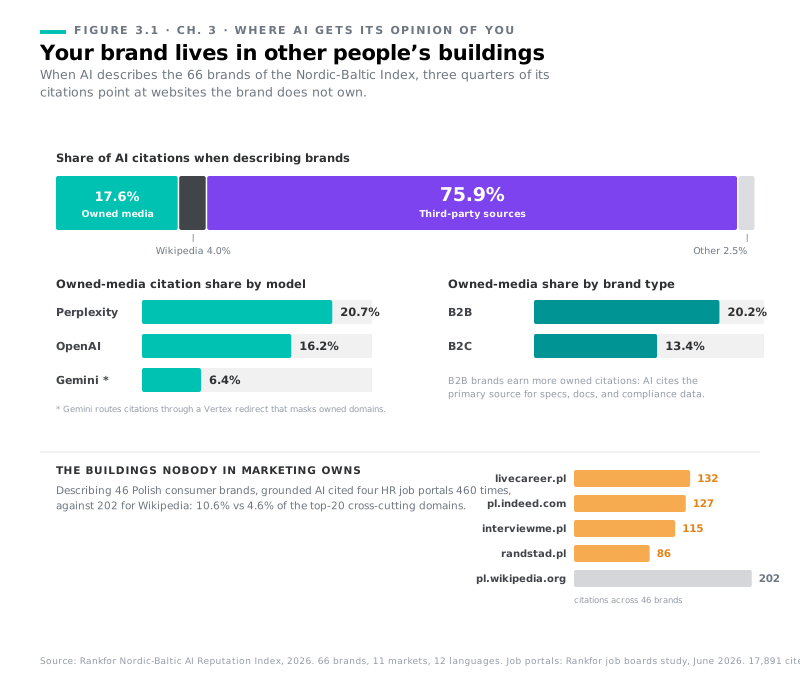
- About 85% of the sources AI cites sit off your own website (85.7% across 167,551 citations)
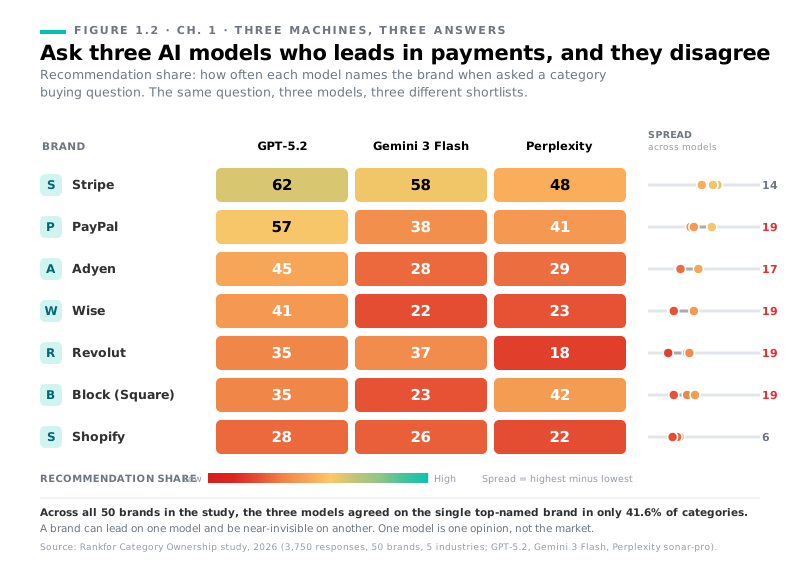
- Three models agreed on the top brand only 41.6% of the time (50 brands, 3,750 answers)
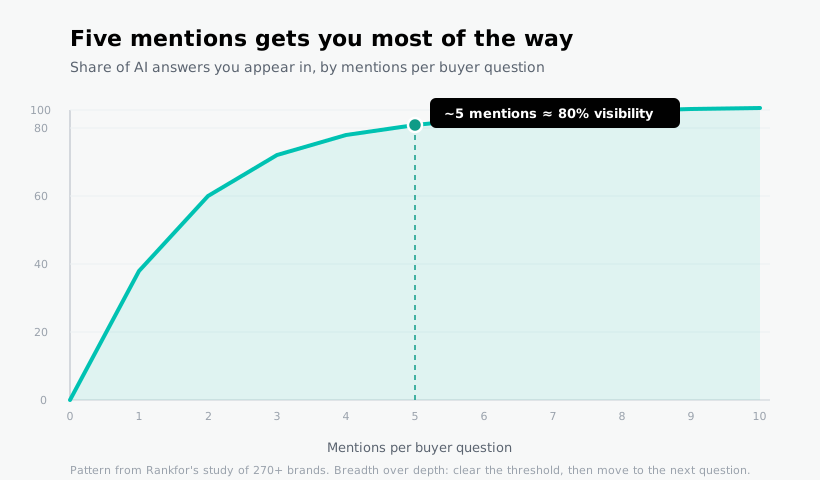
- About five credible mentions per buyer question gets you to roughly 80% presence (operating rule of thumb)
- Cited sources turn over 56 to 74% week to week (Kevin Indig, Search Engine Land, 2026)
To know if AI recommends your brand, ask the AI the same questions your buyers ask, then read each answer for two things: does your brand appear, and which sources did the model quote to build that answer. You can do this free with Answer Trail. It runs your category questions across the models buyers use and shows where you are missing. If your brand is absent, the fix is to earn mentions on the third-party pages AI already trusts, because about 85% of the sources AI cites sit off your own website.
What does it mean for AI to recommend your brand?
When a buyer asks ChatGPT or Gemini which tool to use, the model writes one answer and quotes a few sources to back it. For AI to recommend your brand means your name lands in that answer and the model quotes a source that speaks well of you. This is AI visibility, and the practice of earning it is AEO, answer engine optimization. Each source the model names is a citation. Fewer citations for you means fewer recommendations, and a smaller share of the answers your buyers read. The book Become the Answer lays out the full method.
How do I check if ChatGPT or Gemini recommends my brand today?
Do it by hand first. Open ChatGPT or Gemini, ask the exact question a buyer would ask, and read the answer for your brand name and the sources listed underneath. Run it several times, because the same question gives a different answer on different days. In our study of 50 brands across three models (3,750 answers), the models agreed on the top brand only 41.6% of the time. The sources AI quotes are not steady either: an independent analysis by Kevin Indig (Search Engine Land, 2026) found the cited sources turn over by 56 to 74% from one week to the next. One check is a snapshot. To see the real picture you need many runs across the models your buyers actually use.
Is checking my AI visibility free?
Yes. Answer Trail is our free audit. It runs your category questions across the models buyers reach for, shows you every answer, marks where your brand is missing, and lists the sources AI quoted in place of your brand. It tracks ChatGPT and Gemini, the two models most buyers use. It is built in Europe and aligned with GDPR and the EU AI Act, so you can run it without a data-transfer headache. No cost, and no sales call to see your gaps.
Why is my brand missing from AI answers?
Because the answer is built mostly from pages you do not own. About 85% of the sources AI cites when it answers a buyer question sit off your own website. We measured 85.7% across 167,551 citations in our cross-market study. A perfect page on your own website cannot move the answer while the model is reading comparison articles, forums, and third-party lists to decide who to name. If those pages never mention you, the model has nothing to quote, and you stay out of the answer.
How many mentions do I need to appear in an AI answer?
About five credible mentions per buyer question gets a brand into roughly 80% of the answers for that question. Once you clear that bar, stop polishing it and move to the next question. Breadth beats depth. That is our operating rule of thumb, drawn from the same body of work across 270+ brands in our research corpus: a handful of trusted mentions moves the answer far more than one heavily optimized page. Being present across many questions with five solid mentions each is cheaper, and wins more, than piling twenty mentions behind one.
AI visibility vs SEO: what is the difference?
SEO earns a ranked link on a results page and waits for a click. AI visibility earns a mention inside the answer itself, where there is often no click at all. SEO rewards your own pages and your domain authority. AI visibility rewards mentions across the pages AI trusts, most of them not yours. Keep SEO as your base. AI visibility is the layer on top.
| SEO | AI visibility | |
|---|---|---|
| Where you win | a ranked link on the results page | your name inside the AI answer |
| What moves it | your pages, links, domain authority | mentions across third-party pages AI quotes |
| How you prove it | clicks and rankings | citations and recommendation share |
Which third-party sources should I earn mentions on?
Start where AI already reads. Comparison articles and best-tool lists are the highest-value format, because that is where buyers decide and where models look for a verdict. LinkedIn Pulse moves fast, sometimes within days. Reddit threads where your exact question is being asked carry real weight. Clean, public code examples on GitHub get pulled into models like Claude. Earn five of these per question, confirm you now appear, then move to the next one.
How do I know it is working?
Two ways. Measure the next action a person takes, because the AI answer often removes the click you used to count. And ask every new customer one plain question: how did you find us. Self-reported answers are the one signal marketers still trust. Watch the share of leads who say AI or ChatGPT sent them, and watch that share climb month over month.
How do I fix the gaps and keep them fixed?
Answer Trail shows the gaps and generates Visibility Booster pages, written answer-first with the buyer's follow-up question built in, to fill them. To keep the gaps closed you have to watch the answers over time, because the sources turn over week to week. The platform does this by machine: per-model and per-language tracking, the sources cited for each question, Spotlight for prompt-level visibility, and the Rankfor Index, one reputation score you can take to the board.
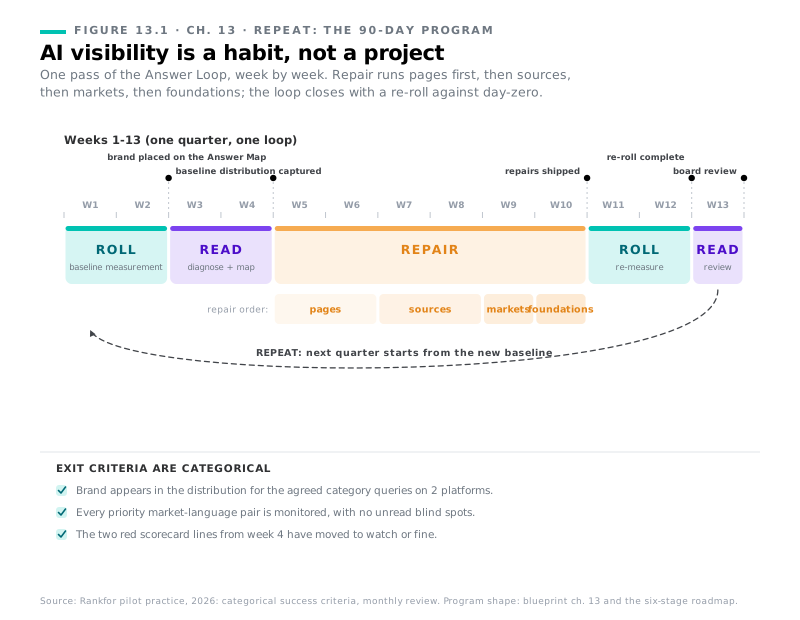
Free audit or paid monitoring, in plain terms:
- Free Answer Trail audit: a snapshot of your gaps today, plus the pages to fix them.
- Paid platform monitoring: daily tracking across models and languages, the cited sources behind every answer, and your Rankfor Index over time.
Start with the free audit. Run Answer Trail on your top buyer question today, read where AI leaves you out, and earn your first five mentions. When you want to watch it every day, move to the platform, and join the BeVisible club to compare notes with marketers doing the same work.
Continue Reading
Where AI Gets Its Answers: 167,551 Citations Behind Brand Reputation
A cross-market citation dataset: 167,551 URL-grounded citations across 128 brands, 13 languages, and 12 markets from GPT, Gemini, and Perplexity. AI grounds brand answers in third-party sources 85.7% of the time; 18% of domains carry 80% of citations; Wikipedia is the top domain in 11 of 12 languages. Open under CC-BY-4.0 with DOI.
Category Ownership Index: The Dataset Behind Our 50 Brand Profiles
The open dataset behind our 50 brand profiles: 3,750 responses from GPT-5.2, Gemini 3 Flash, and Perplexity sonar-pro to 250 brand-free buying questions across 5 industries, under a dice-roll stability protocol. Three metrics (COI, CVI, DS), mean Gini 0.284, 8% competitive vacuums, and 41.6% cross-model agreement. CC-BY-4.0 on Kaggle and Zenodo.
The State of AI Visibility: Why Brands Are Losing Control Inside AI Answers
Search didn't disappear. It stopped being the place where decisions happen. Traditional SEO assumed that if you ranked well, you would be discovered. AI doesn't work that way. This thought leadership piece defines why AI visibility matters and introduces the four dimensions of AI visibility: Presence, Relevance, Usefulness, and Trust.
The "Best Of" Trap: Why Self-Promotional Listicles Are Losing Google and Winning ChatGPT
Three signals in one week: Google penalized self-promotional listicles (SaaS brands losing 34-49% visibility), reduced crawl limits by 86.7%, while Ahrefs found 44% of ChatGPT citations come from those exact listicles. Google is shrinking, AI is expanding. Includes a 5-minute brand audit playbook and split strategy for navigating both discovery systems.
BeVisible Club
Get research like this before we publish it.
New AI visibility studies, ranking patterns, and source-stack data delivered to your inbox a week before they go public.
Join BeVisible ClubWant to Know How AI Sees Your Brand?
Rankfor.AI measures your brand's AI visibility across all major platforms and provides actionable recommendations.
About the Author

Founder
Dmitrij Żatuchin is the founder of Rankfor.AI. A computer scientist with a PhD in semantic web technologies, he bridges the gap between how AI reasons about brands and how brands want to be understood. With over two decades of software architecture experience and academic roles at Estonian Business School, Dmitrij builds the measurement infrastructure brands need to transition from optimizing for search engines to becoming visible for reasoning engines.