One board-ready score with every prompt and answer behind it. Rebuilding that number by hand costs EUR 3,240 to EUR 6,480 a year.
You need one number you can say out loud in a board meeting and still be standing when somebody asks where it came from.
The question arrives the same way every quarter. Does AI name us when a buyer asks the category question? Is that better or worse than last quarter? How do we sit against the two names everyone in the room already worries about? Then comes the follow-up that ends the meeting: fine, but what are they saying about us, and who built that figure?
Right now the answer is a screenshot of a chat window from last Tuesday. It does not line up against last month, it names no source, and the analyst who produced the previous version counted things slightly differently. So the movement you report upstairs may have come out of the method while the market stood still.
What it costs today
In-house and analyst time at EUR 90 an hour, agency time at EUR 120.
| The board question | How it gets answered by hand | Cost |
|---|---|---|
| Does AI name us at all | 25 buyer prompts written once, then run and tallied on three models, 7 h at EUR 90 | EUR 630, first round |
| Is that number still true this month | re-run the battery, re-tally by brand and position, redraw the chart, 3 to 6 h at EUR 90 | EUR 270 to 540 a month, EUR 3,240 to 6,480 a year |
| Does the answer even hold still | one question rolled ten times and tallied, 1.5 to 3 h at EUR 90 | EUR 135 to 270 a question |
| Where do we sit against two rivals | the same seven-hour audit round on each, every month, at EUR 90 | EUR 1,260 a month, EUR 15,120 a year |
| Give me something I can circulate | pull the numbers, build the charts, write the narrative, brand the deck, 8 to 16 h at EUR 120 | EUR 960 to 1,920 a cycle |
Line one is the build. Line two is the same work repeating, and it never stops.
Marketer is EUR 196 a month, EUR 2,352 a year, and it carries the score, the trend and the report. The ten-roll stability run and the rival project both need Strategist at EUR 496 a month. At EUR 270 a stability question, the second question covers the plan; at EUR 135, the fourth does.
The workflow
Five playbooks, 27 minutes, in the order the conversation with your board actually goes.
1. The number. Does AI name you at all? registers the brand, asks you seven questions once, and runs one scan. What comes back is a score out of 100 with its band beside it and four named metrics under it: Brand Recall, Message Alignment, Value Understanding, Content Structure. Click the mention count and every prompt opens, the buyer type that asked it and the model’s answer beside it. Click Competitors mentioned and read the brands the model recommended while you were absent, with a count on each. PDF for the board pack, CSV for whoever wants to argue with the method.
2. Why one screenshot proves nothing. Somebody will open ChatGPT on a phone in that meeting, type the category question once, see your name and conclude the problem is imaginary. Show how unstable the AI answer really is rolls one question ten times against one model and sorts every brand into four bands by how many rolls named it: Always at 80% of rolls and above, Frequent from 50, Occasional from 20, Rare below that. A rival sitting in Always beside your own name sitting in Occasional is the slide, and the ten answers sit underneath it in full.
3. The rival, measured your way. Track a rival on your own chart makes the competitor a project of its own: same crawl, same model, same prompt discipline. Then a Compare with picker draws its line on your axis over the same window, and one metric switch moves both lines together across the Rankfor Index and its seven pillars. The gap you report upstairs came out of two independent crawls run the same way.
4. The direction, with the working shown. Prove the needle moved, with a chart is the quarterly answer. A dated line you can set to a year, the seven parts of the score, each with the weight it contributed so the total is arithmetic somebody can check, and sentiment theme by theme with a positive share and a signed value per theme. Then the part that closes the meeting: one export listing every cited page, grouped positive, neutral and negative.
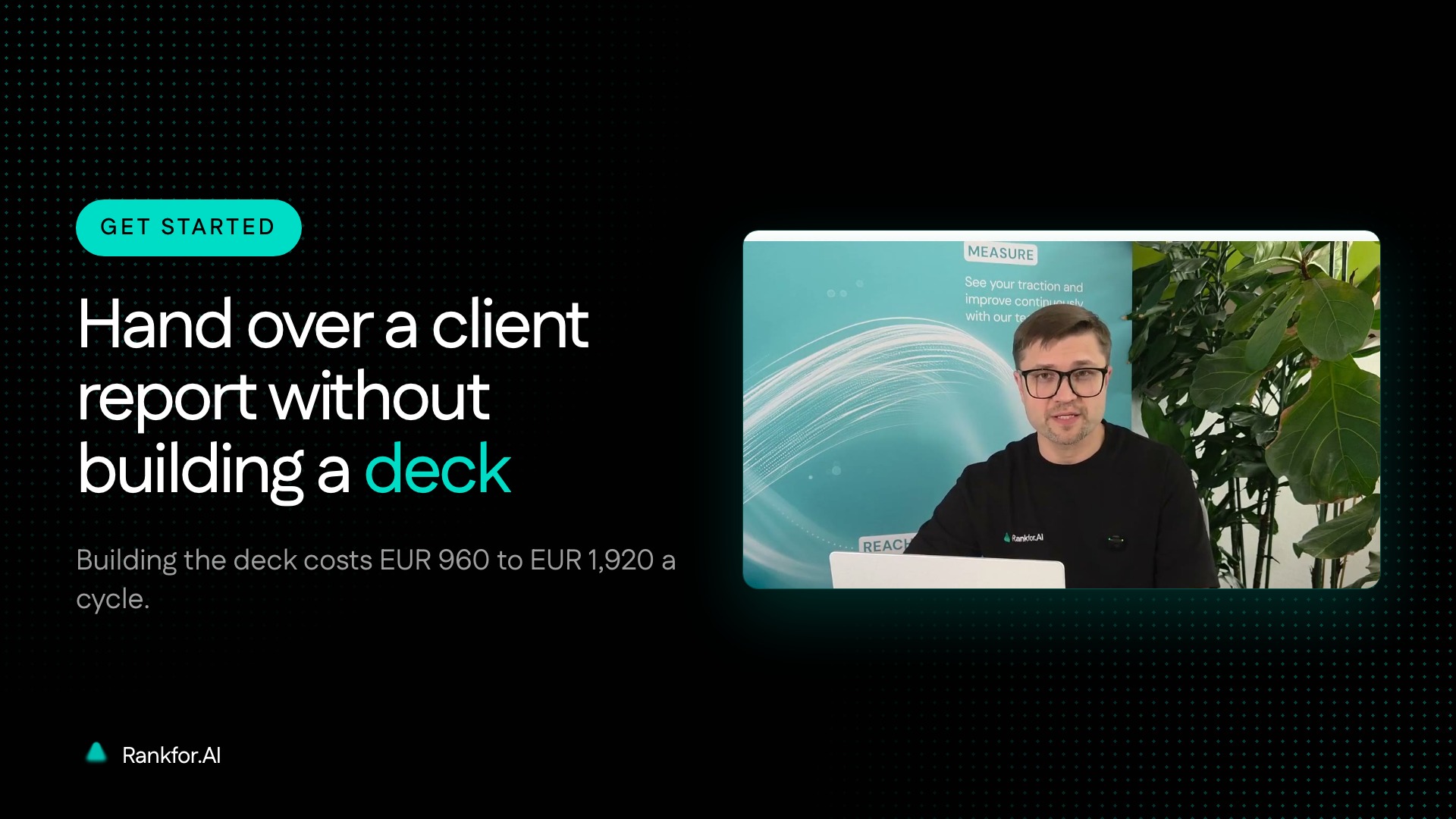
5. The thing you send. Hand over a client report without building a deck films an agency handing a report to a client, and the same screen builds the link you circulate before a board meeting. Pick the brand, pick your accent colour, type who it is prepared for. Out comes a twelve-slide deck behind a six-digit PIN that opens in a browser with no account, a PDF of the same page for the inbox, and a sources CSV. The link is fixed to the run it was built from, so what you send today reads the same next week.
What this does not do
Nothing watches the number for you. There is no monitoring product here and no alert when a figure moves. Each project takes one scan per model per calendar month, refused server-side after that, and one chart point is one scan. A ten-point line is ten months of scanning. The cap is what keeps the points comparable.
Two rivals, and the comparison leaves as a screenshot. A workspace holds three projects on Strategist, so you and two competitors, and nothing lifts that ceiling. Competitor projects stay out of the report generator by design and the chart card has no export button, so the two-line chart reaches the board pack as an image you take yourself.
Three models. Gemini, ChatGPT and Grok. Claude and Perplexity sit outside the picker and we publish no numbers for them.
No statistics, and no promised position. The consistency and overlap scores are weighted composites between 0 and 1 shown as percentages, with no confidence levels and no margins of error. The themes behind the sentiment score are a fixed set carried on every prompt, so nothing there is discovered inside your own data. Rankfor.AI measures what the models say and gives you the evidence underneath it. Nobody can promise you a place in an answer.
Start here
Watch Does AI name you at all?. Five minutes and forty-three seconds.
It comes first because it is the only one in the set that hands you a number in a single sitting. Three and four need months of scans before a line means anything, and two needs Strategist. This one needs a website address, seven answers and one scan. And when somebody asks where the number came from, you click through to the questions themselves with the model’s answers beside them, which is the part that survives the challenge.
Then watch Show how unstable the AI answer really is, because the meeting where you ask for the budget is the meeting where somebody produces a phone.