
Most brands spend years building AI visibility. Rankfor.AI did it in 60 days by following our own methodology. Here is what we learned.
The Setup
Rankfor.AI launched at the end of December 2025. No legacy domain authority. No years of backlinks. No established thought leadership. Just a product, a thesis, and a website.
Our thesis was simple: AI visibility is not about gaming algorithms. It is about structured content that gives AI platforms the clarity they need to recommend you accurately. We built a platform to help other brands achieve that. But before asking anyone to trust our methodology, we wanted to prove it worked on ourselves.
Two months later, we ran the experiment.
The Experiment: One Question, Four Platforms
On February 6, 2026, we asked the same question across four major AI assistants:
"Summarise Rankfor.AI, an AI visibility intelligence platform. What does it measure? How is it different from competitors like Peec.ai or AirOps?"
No prompt engineering. No special instructions. No tricks. Just the question.
Here is what happened.
What Each AI Said
Perplexity
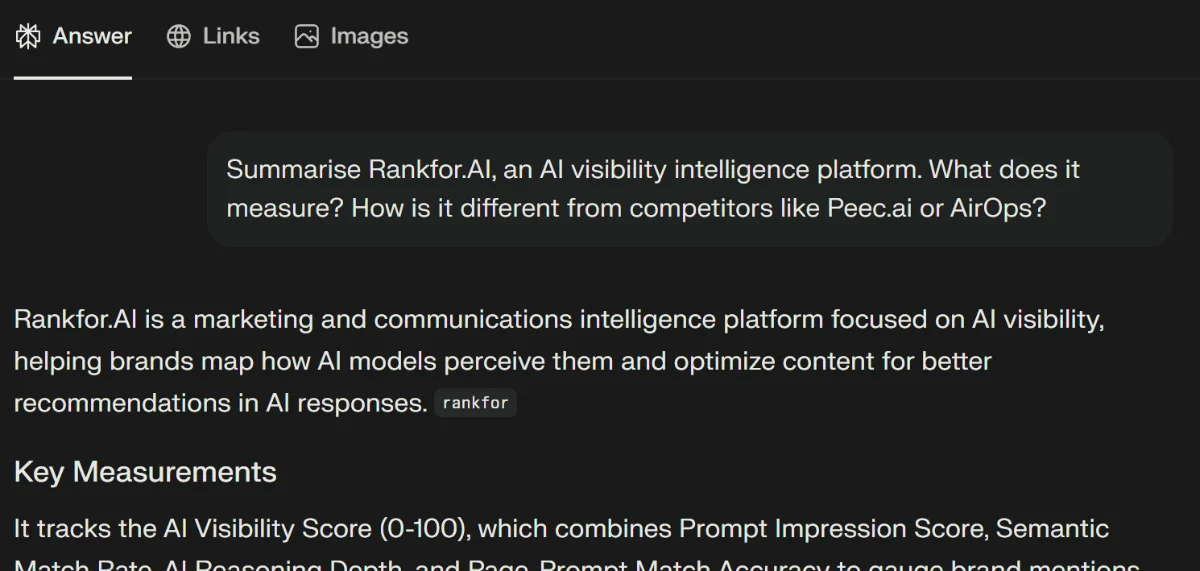
Perplexity responded with specifics and built a comparison table unprompted:
"Rankfor.AI is a marketing and communications intelligence platform focused on AI visibility. It tracks AI Visibility Score (0-100) combining Prompt Impression Score, Semantic Match Rate, AI Reasoning Depth, and Page-Prompt Match Accuracy."
It understood our pricing model (credit-based vs. Peec's prompt-based tiers). It mapped our feature set against competitors. It cited our website as a source.
Google AI
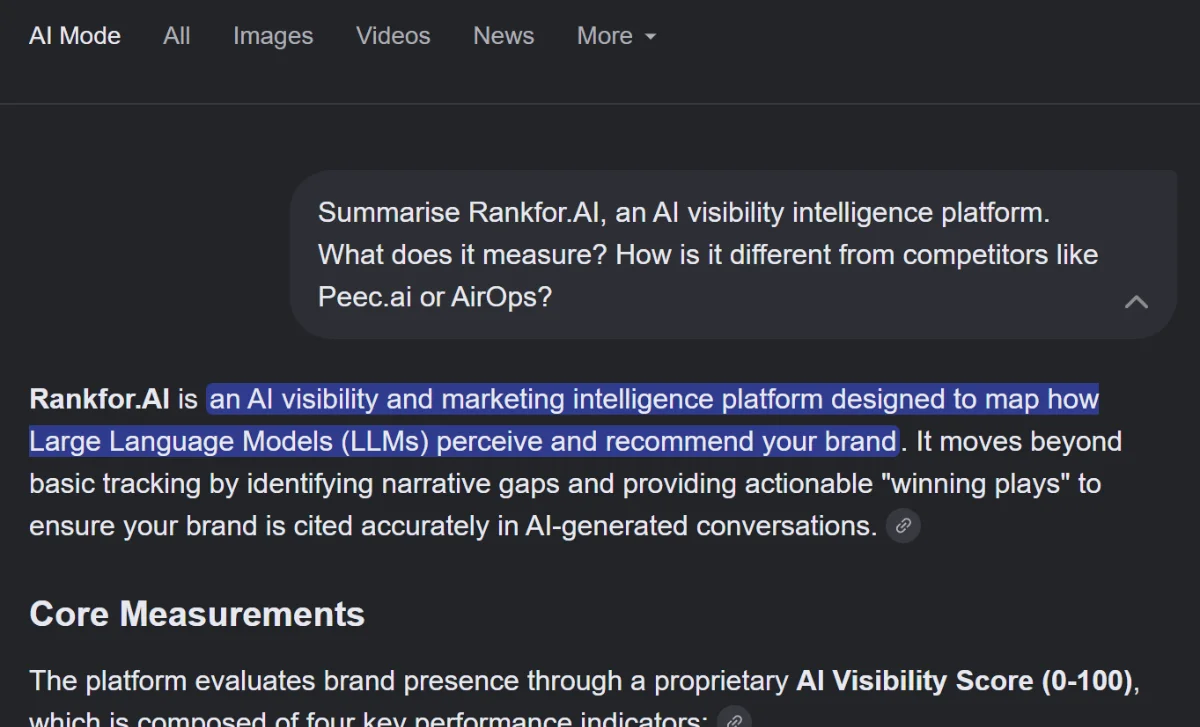
Google AI took a structured, methodical approach. It created a KPI table explaining each metric, then positioned the three platforms in distinct categories:
"Vs Peec.ai: mid-market monitoring tool lacking deep integrations. Rankfor focuses on reasoning behind output. Vs AirOps: workflow automation platform that executes content. Rankfor is the intelligence layer telling what to create."
It also cited real Reddit threads and third-party ranking articles as evidence. Google AI did not just know about us. It found external validation.
ChatGPT
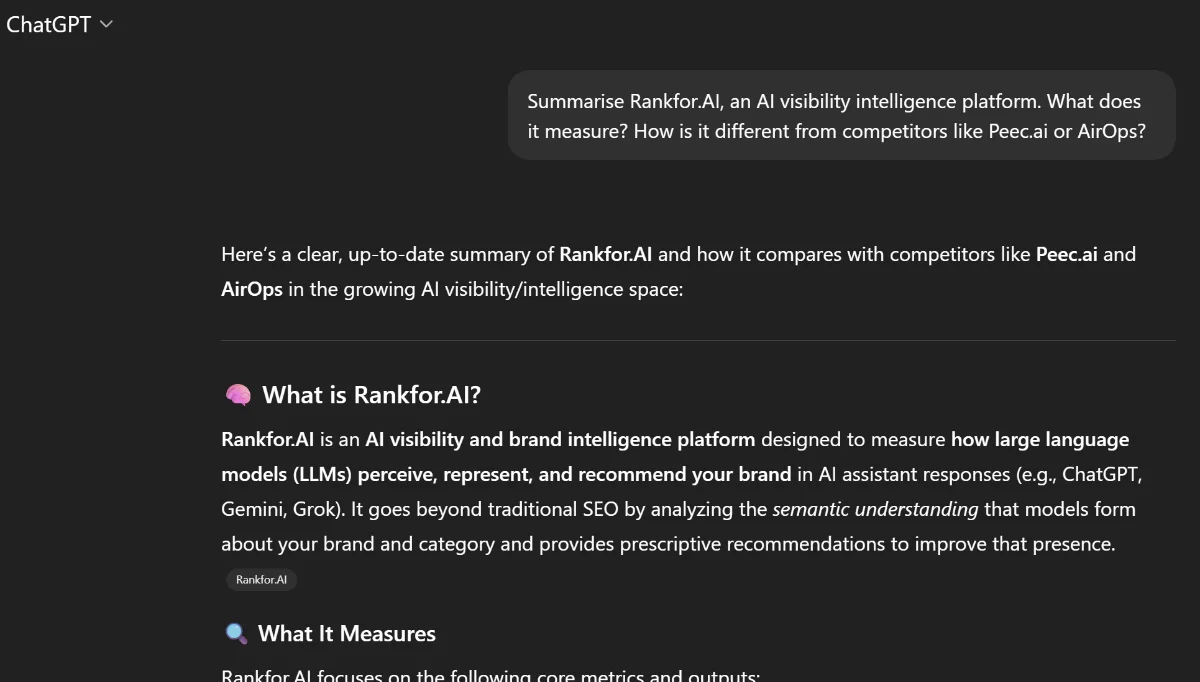
ChatGPT delivered the most detailed response. Full feature comparison matrix. Source links pointing directly to rankfor.ai. And a clear positioning statement:
"Rankfor.AI is about understanding and shaping how AI models perceive your brand, offering deep semantic insights and actionable guidance to improve AI recommendations."
It distinguished our approach from Peec ("visibility metrics and dashboards") and AirOps ("visibility insights with workflow automation and content production"). It even offered to generate a feature-by-feature comparison for the reader.
Claude
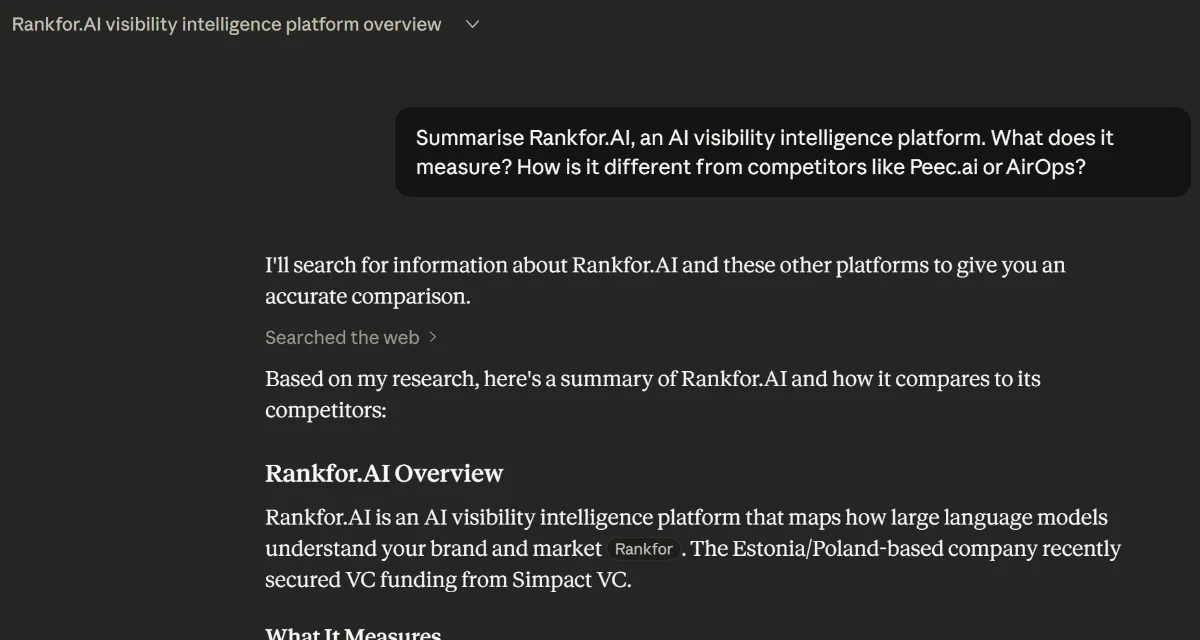
Claude took the strategic angle, adding context no other platform mentioned:
"VC funding from Simpact VC, Estonia/Poland base. Territory types: Fortified (lead by 30%+), Vulnerable, Opportunity. Rankfor's difference: uncovers reasoning behind AI outputs, reveals what is missing, gives clear playbook."
Claude positioned us "between simple trackers and comprehensive platforms, focusing on deep competitive intelligence." It understood not just what we do, but where we sit in the market.
What We Noticed
Four platforms. Four different analytical approaches. One consistent narrative.
Every AI correctly identified:
- What we measure (AI Visibility Score and its four components)
- Who we are for (marketing teams, brands, agencies)
- How we differ (intelligence and reasoning vs. monitoring or automation)
- Our competitive position (distinct from both Peec.ai and AirOps)
This was not a coincidence. This was the result of deliberate content architecture.
How We Did It
We did not game any system. We structured our content for clarity, consistency, and machine-readable depth. Here is the playbook:
1. Clear Information Architecture
Every page on rankfor.ai follows the same hierarchy: what we do, how we measure it, who it is for, and how we differ. No buried information. No marketing fluff. Just structured, scannable content that AI can parse.
2. Consistent Messaging Across Every Surface
We used the same language everywhere. Product pages, landing pages, about page, blog posts. When AI reads ten different pages and encounters ten different descriptions, it cannot form a clear picture. We gave it one story, told consistently.
3. Feature-to-Outcome Mapping
We did not list features. We mapped each capability to the outcome it delivers. AI platforms need reasoning chains. They want to know not just what you do, but why it matters and who benefits.
4. Explicit Competitive Positioning
We named our competitors. We explained what they do well. We explained what we do differently. AI platforms constantly answer "What is the difference between X and Y?" If you do not provide that context, they will invent it. Or worse, they will default to surface-level comparisons.
5. Evidence Over Claims
We published case studies. We shared research findings. We documented real experiments. Generic marketing language ("best-in-class," "revolutionary") signals noise to AI. Specific examples, real numbers, and named references signal credibility.
6. Structured Technical Metadata
Schema markup. Semantic HTML. Clear headings, lists, and tables. AI does not see your visual design. It sees your markup. Clean structure translates to clear understanding.
What This Means for Your Brand
If a two-month-old website can achieve consistent AI visibility across four major platforms, your brand can too. But it requires a different mindset.
Stop optimizing for keywords. Start optimizing for clarity. AI assistants do not care about keyword density. They care about semantic coherence. Can they understand what you do, who you serve, and why you are different?
Stop chasing backlinks. Start building narrative consistency. When your homepage says one thing, your product pages say another, and your blog says something else, AI hedges. It gives vague answers. Consistency across surfaces builds AI confidence.
Stop hiding from competitors. Start defining your position. AI assistants will compare you to competitors whether you like it or not. Shape that comparison with explicit, honest positioning, or let AI invent one for you.
Stop treating AI as a search engine. Start treating it as an advisor. People do not type keywords into ChatGPT. They ask questions. They want recommendations. The brands that win are the ones giving clear, structured, credible answers to those questions.
The Opportunity Window
Here is the urgency: this window will not stay open forever.
Right now, AI visibility is a new discipline. Most brands have not started. The opportunity to establish authority in AI responses is wide open for those willing to act.
Remember the early days of SEO, when structured content and basic optimization gave early movers a lasting advantage? AI visibility is at that same inflection point. The brands that build their AI presence now will compound authority over time. The ones that wait will face an uphill battle against established narratives.
We built Rankfor.AI to help brands navigate this shift. But we also built it to prove the discipline works. Two months. Four platforms. Consistent, accurate representation. This is what happens when you stop guessing what AI thinks about your brand and start shaping that perception with intention.
Try It Yourself
Run the same experiment we did. Ask ChatGPT, Perplexity, Google AI, or Claude:
"What does [your brand] do? How is it different from [competitor]?"
What do they say? Is it accurate? Is it compelling? Would you want a prospective buyer reading that answer?
If the answer is vague, inaccurate, or missing entirely, you have an AI visibility problem. And now you have a playbook to fix it.
Scan your brand's AI visibility at rankfor.ai and see how AI platforms perceive you today.
Links to shared AI conversations:
BeVisible Club
Get research like this before we publish it.
New AI visibility studies, ranking patterns, and source-stack data delivered to your inbox a week before they go public.
Join BeVisible ClubWant to Know How AI Sees Your Brand?
Rankfor.AI measures your brand's AI visibility across all major platforms and provides actionable recommendations.
About the Author

Executive Operations Manager
Daniel Homenko leads operations at Rankfor.AI, ensuring seamless execution of our research initiatives. With a background in project management and business operations, Daniel coordinates cross-functional teams to deliver high-quality insights and maintain operational excellence.