
Key Findings
- 453 of 900 shortlist answers name the company when the buyer leaves the name out (50%)
- Of 90 shortlist questions, 30 name the company in all ten answers and 29 in none
- Six companies are named in every shortlist answer: Lightyear, Milrem Robotics, Montonio, Pactum, Pipedrive and Wise
- Gemini 3.7 Flash names the company in 45% of answers to questions that leave the name out, GPT-5.6 Sol in 37%
- In the 22 companies read in full, 11% of citations go to the company’s own pages and 55% to other companies in the market
What GPT-5.6 Sol and Gemini 3.7 Flash answered, 2,400 times, to 240 buyer questions about the 30 companies on TOPTech30 2026.
A buyer who asks an AI assistant “which provider should we choose?” gets a short list. We wanted to know how often Estonia’s most valuable technology companies are on it.
We took TOPTech30 2026, the valuation ranking published by Prudentia and Siena Secondary Fund, and measured all 30 companies. For each one we chose one market where it sells, wrote eight buyer questions in that market’s language and asked two AI engines each question five times.
Disclosure. Rankfor.AI sells AI visibility audits and a managed service. Ridango, one of the 30 companies, is a Rankfor.AI customer. Rankfor.AI has sent ten of the companies their own report so far and sends the others theirs on request. The study was not commissioned or paid for by any of the companies or by the publishers of TOPTech30.
The short answer
- Asked for a shortlist, with the name left out, AI names the company in 453 of 900 answers (50%).
- Of 90 shortlist questions, 30 name the company in every answer and 29 in none.
- Six companies are named in every shortlist answer. Five are named in none, in the market measured.
- Gemini 3.7 Flash names the company in 45% of answers to questions that leave the name out. GPT-5.6 Sol does in 37%.
- In the 22 companies whose answers we read in full, 11% of citations go to the company’s own pages and 55% to other companies in the market.
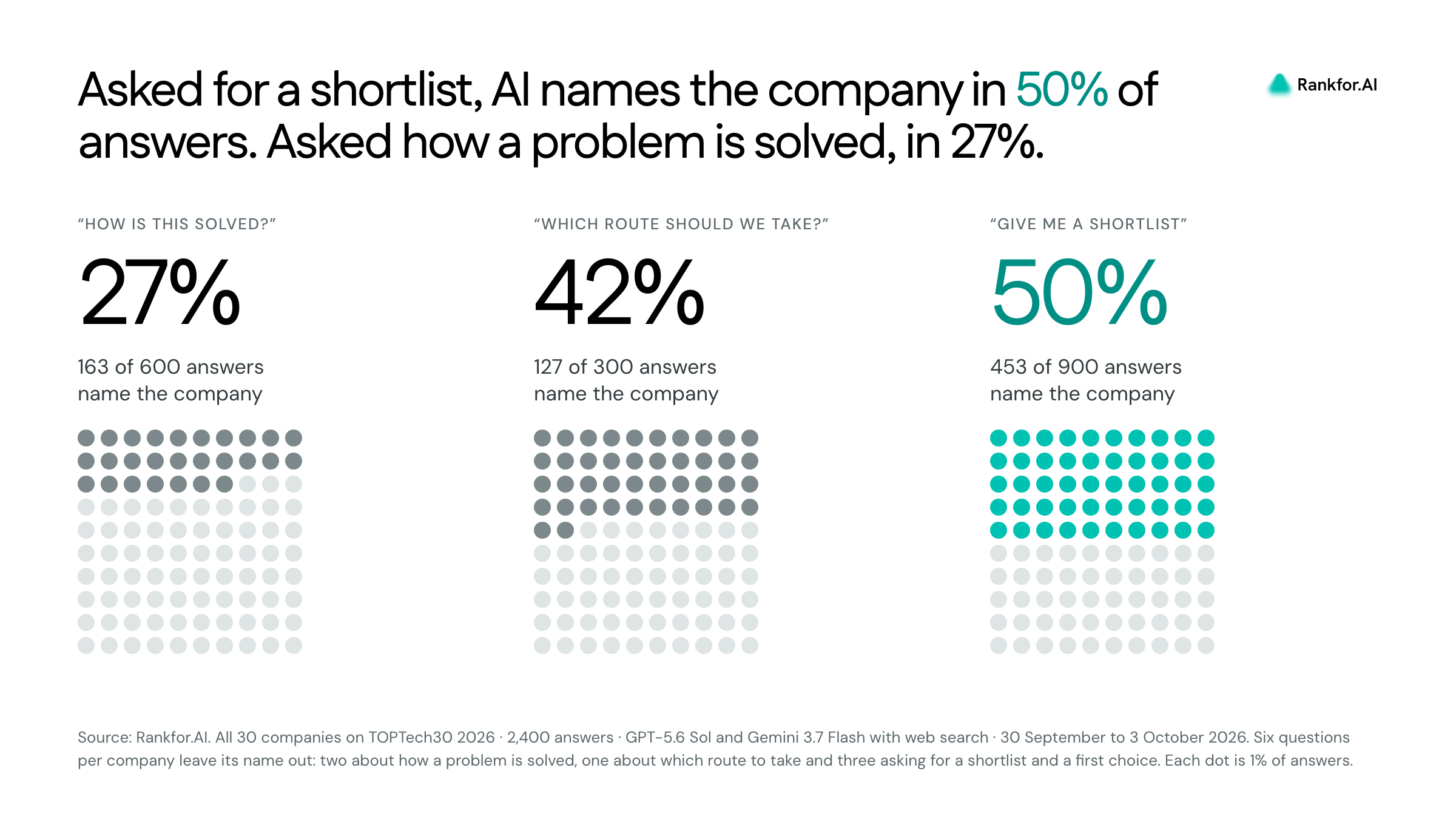
Half of the shortlists
Each company has three shortlist questions. A buyer describes a need, asks for the top providers and asks which one to choose first. The company’s name, products and domains are left out.
Across 900 answers to those questions, the company is named in 453.
The share falls when the buyer is earlier in the decision. On questions about how a problem is solved, the company is named in 163 of 600 answers (27%). On the question about which route to take, it is named in 127 of 300 (42%).
Across all six questions that leave the name out, the figure is 743 of 1,800 (41%).
For most questions it is every answer or none
We expected companies to be more or less visible. What we found is closer to on or off, question by question.
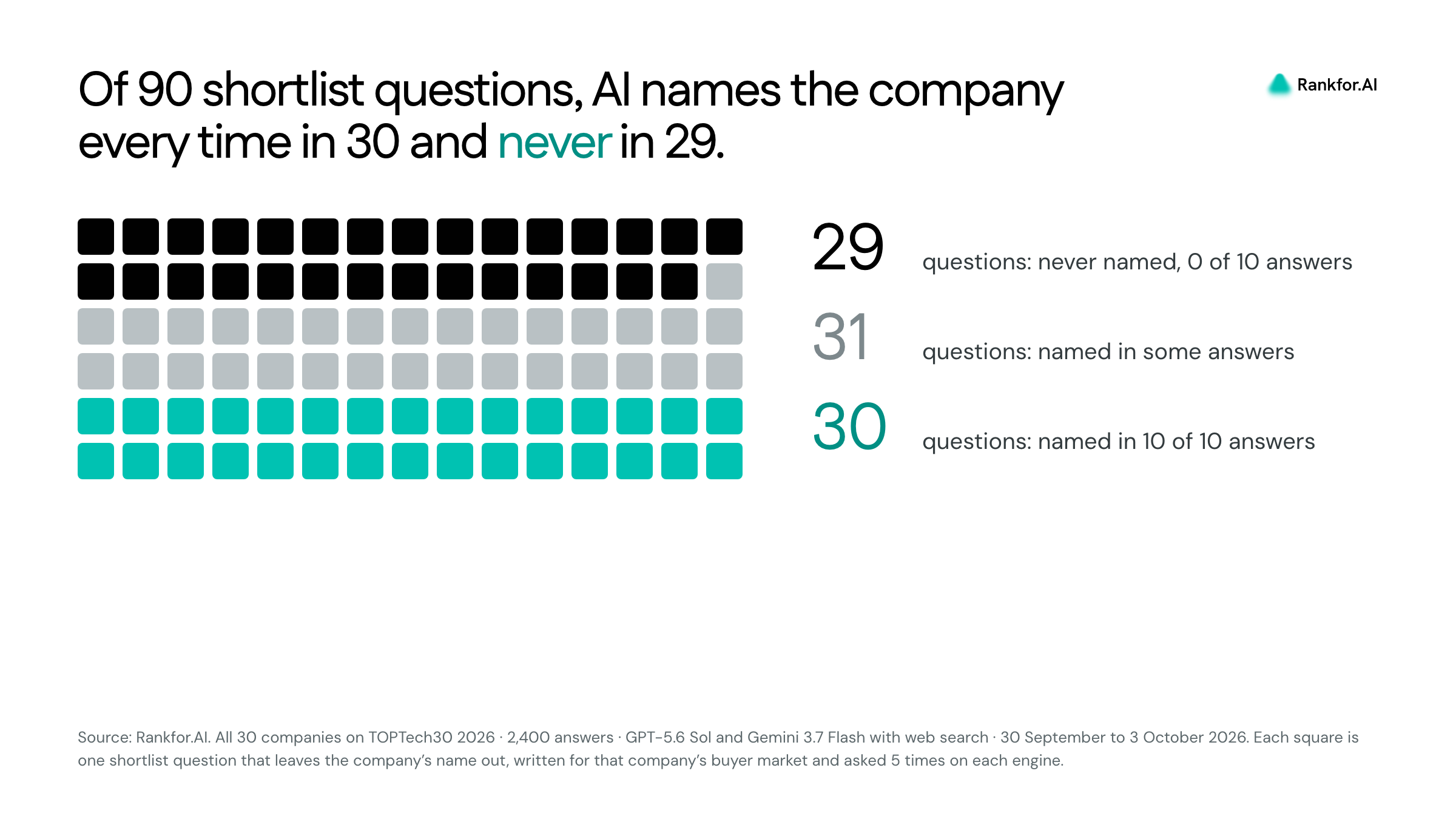
Each of the 90 squares is one shortlist question for one company, asked ten times. In 30 of them the company is named all ten times. In 29 it is never named. 31 sit in between.
Two examples from the reports:
- Scoro is named in 10 of 10 answers for a marketing agency choosing a professional services platform, and in 0 of 10 for an architecture and engineering practice.
- Wallester is named in 4 of its 60 answers, and all four answer the same question, from an agency that needs a few hundred virtual cards.
A company that tests one question about itself learns very little. The useful picture is the set of questions its buyers ask.
Six companies every time, five in none
Six companies are named in all 30 of their shortlist answers: Lightyear, Milrem Robotics, Montonio, Pactum, Pipedrive and Wise. Montonio was measured in Estonian for Estonian online shops and Lightyear in Hungarian for Hungarian investors.
Five companies are named in none of theirs: Ark Robotics (Europe), Helmes (Germany), KrattWorks (Europe), Nortal (Germany) and Zobi (United States). That result belongs to the market measured. Helmes and Nortal were measured in Germany, and Ark Robotics and KrattWorks on European defence procurement questions.
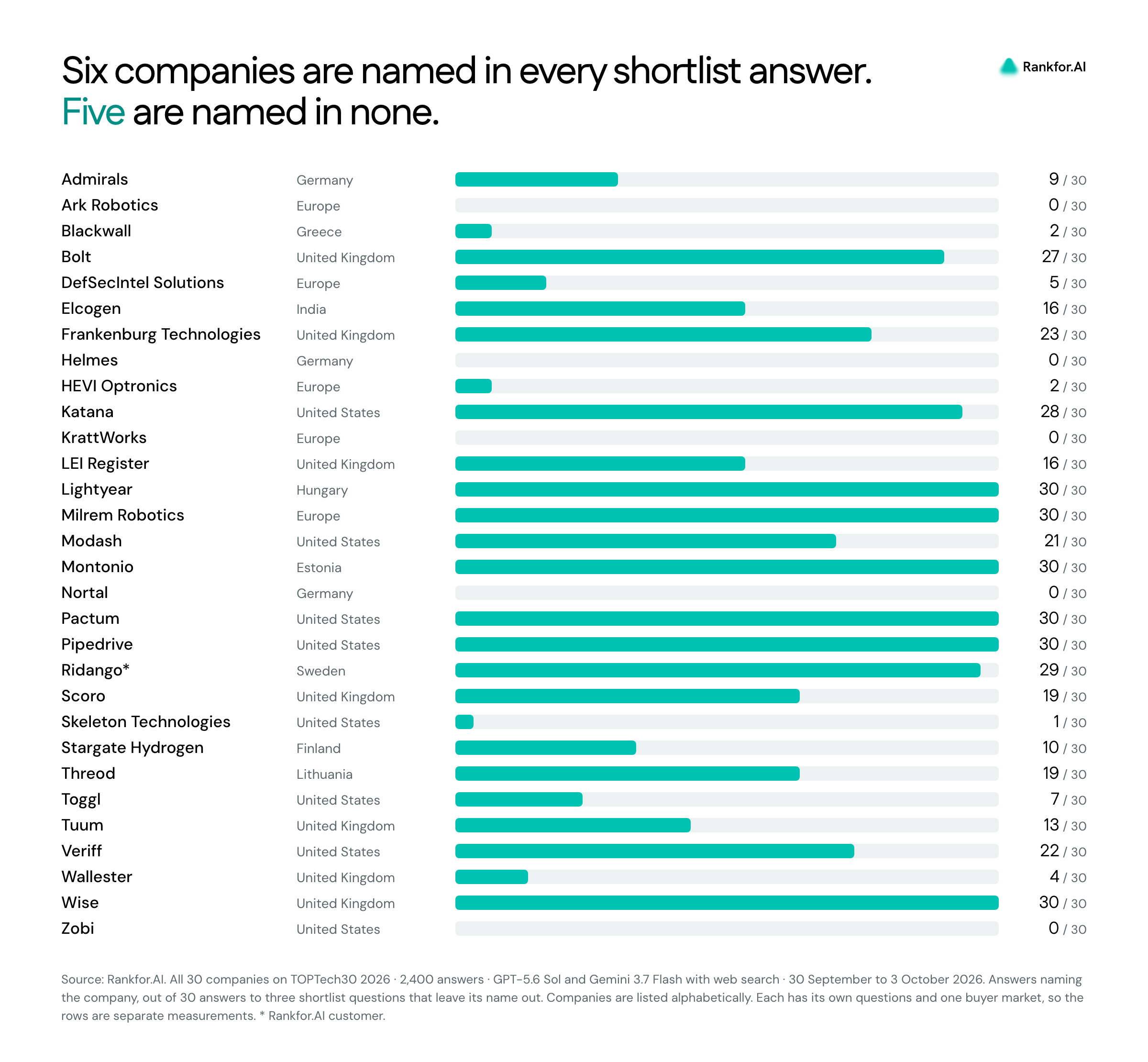
The rows are separate measurements in alphabetical order. Each company has its own questions, market and competitors.
The two engines disagree
Gemini 3.7 Flash names the company in 408 of 900 answers to questions that leave the name out (45%). GPT-5.6 Sol names it in 335 (37%). On 15 of 180 questions, one engine names the company in at least 4 of 5 answers and the other in at most 1.
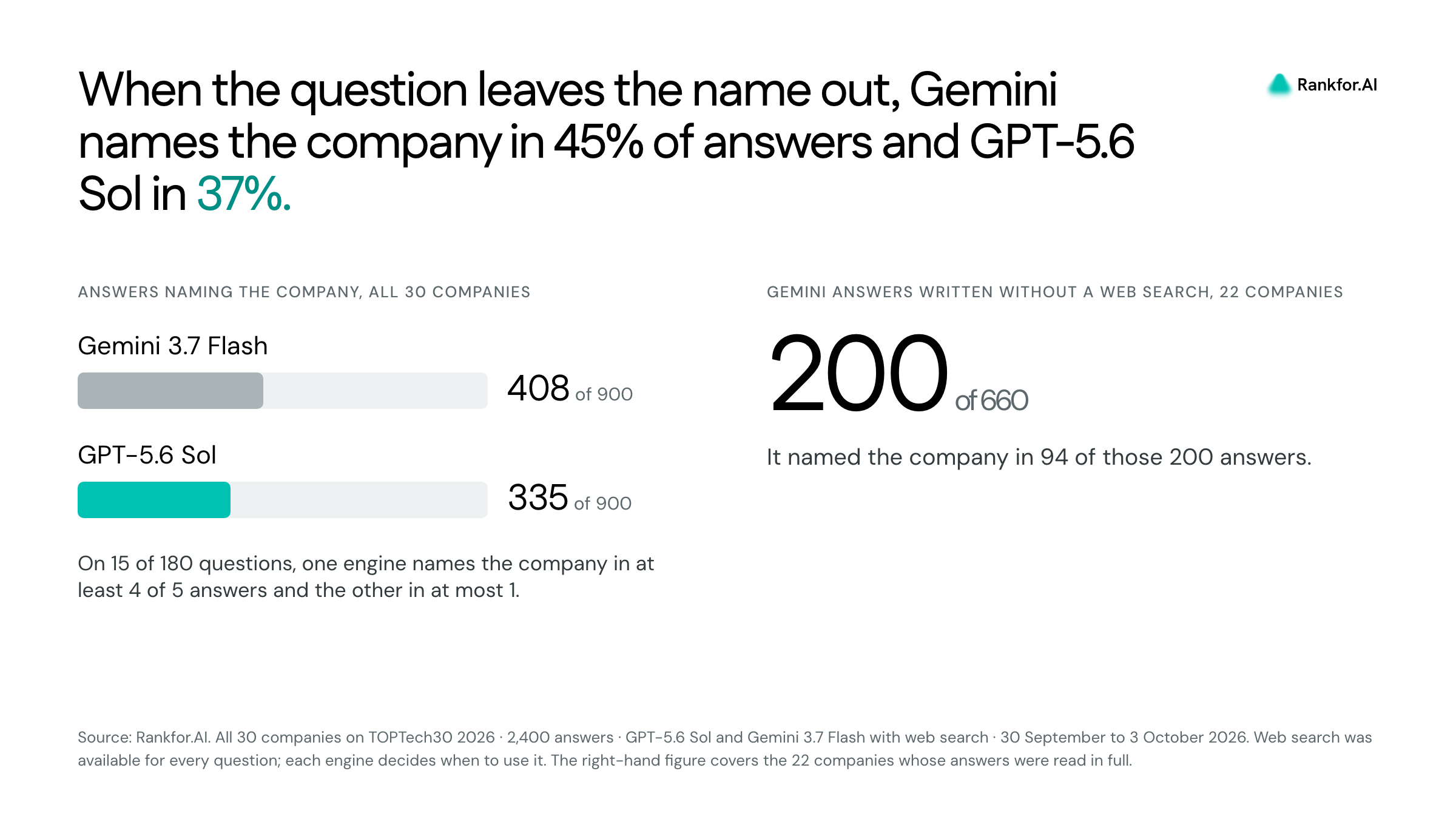
Web search was available for every question. In the 22 companies we read in full, GPT-5.6 Sol returned sources in 652 of 660 answers. Gemini wrote 200 of 660 without searching and named the company in 94 of those.
What we saw in the 22 companies read in full
For 22 companies, two AI coders read every answer and recorded first picks and cited sources. Three things stand out in those 1,760 answers.
Given the name, both engines identify the company. 437 of 440 answers to the questions that name the company describe the right one. The three exceptions are Gemini answers about LEI Register.
Named and picked are separate counts. 703 answers pick one provider first, and the measured company is that pick in 211 (30%). For seven companies it is at least half of the answers that make a pick: Bolt, Katana, Lightyear, Montonio, Pactum, Pipedrive and Ridango (a Rankfor.AI customer).
Other companies’ pages are cited about five times as often as the company’s own. The answers carry 8,616 citations. 55% go to other companies in the market: competitors first, then partners, platforms and customers.
Public bodies and standards receive 15%, the company’s own pages 11%, review and comparison sites 7% and news and trade media 3%.
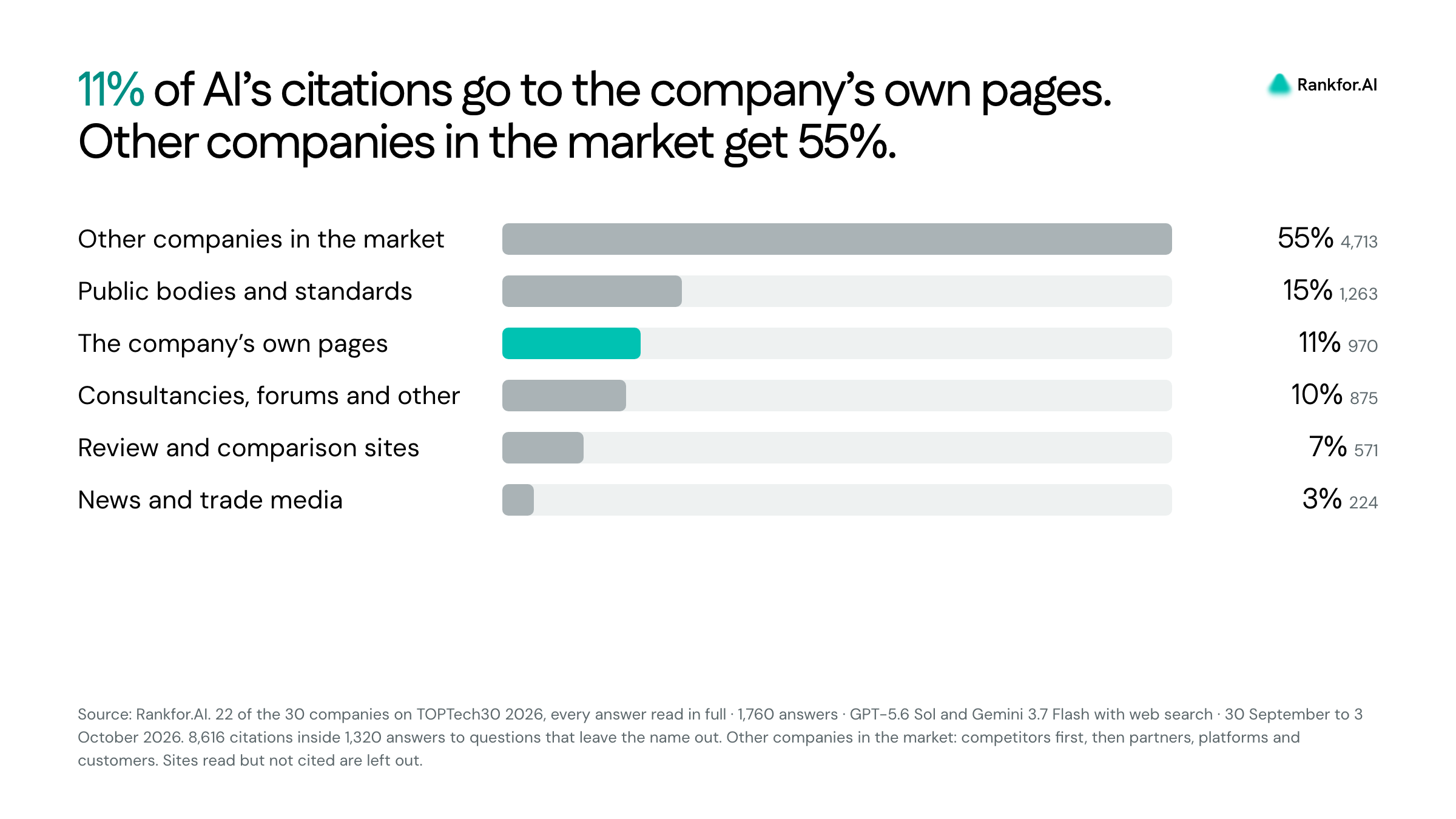
The company’s own pages are cited in 439 of 1,320 answers, so their contents are within the engine’s reach.
What a marketing team can do with this
- Test the questions buyers ask before they know your name. Use the buyer’s market and language. Ask each question several times and on more than one engine.
- List the questions where AI never names you. Each one is a specific buyer and use case. The answers show which companies and sources fill that space.
- Check what your own pages say. AI cites company pages in a third of the answers we read in full. Read them as a buyer’s assistant would.
Results by company
| Company | Product measured | Buyer market | Named, shortlist answers (of 30) | Named, all six questions (of 60) | First pick |
|---|---|---|---|---|---|
| Admirals | CFD and forex brokerage | Germany (German) | 9 | 9 | 3 of 34 |
| Ark Robotics | Autonomy software for unmanned vehicle fleets | Europe (English) | 0 | 0 | not recorded |
| Blackwall | Bot protection for hosting providers | Greece (Greek) | 2 | 2 | 0 of 29 |
| Bolt | Ride-hailing | United Kingdom (English) | 27 | 47 | 12 of 22 |
| DefSecIntel Solutions | Autonomous border and site surveillance | Europe (English) | 5 | 6 | not recorded |
| Elcogen | Solid oxide cells and stacks | India (English) | 16 | 26 | 7 of 33 |
| Frankenburg Technologies | Counter-drone interceptor missiles | United Kingdom (English) | 23 | 40 | not recorded |
| Helmes | Custom software development | Germany (German) | 0 | 0 | 0 of 30 |
| HEVI Optronics | Electro-optical surveillance systems | Europe (English) | 2 | 3 | not recorded |
| Katana | Inventory and manufacturing software | United States (English) | 28 | 57 | 18 of 34 |
| KrattWorks | Aerial target drones | Europe (English) | 0 | 1 | not recorded |
| LEI Register | Legal entity identifiers | United Kingdom (English) | 16 | 23 | 3 of 27 |
| Lightyear | Retail investing | Hungary (Hungarian) | 30 | 55 | 25 of 27 |
| Milrem Robotics | Unmanned ground vehicles | Europe (English) | 30 | 44 | not recorded |
| Modash | Influencer marketing software | United States (English) | 21 | 34 | 11 of 36 |
| Montonio | E-shop payments and shipping | Estonia (Estonian) | 30 | 55 | 33 of 40 |
| Nortal | Public-sector IT services | Germany (German) | 0 | 0 | 0 of 19 |
| Pactum | AI procurement negotiation | United States (English) | 30 | 52 | 22 of 35 |
| Pipedrive | Sales CRM | United States (English) | 30 | 40 | 25 of 36 |
| Ridango* | Public transport ticketing | Sweden (Swedish) | 29 | 38 | 23 of 29 |
| Scoro | Professional services automation | United Kingdom (English) | 19 | 38 | 4 of 39 |
| Skeleton Technologies | Power systems for AI data centres | United States (English) | 1 | 13 | 0 of 40 |
| Stargate Hydrogen | Alkaline electrolysers | Finland (English) | 10 | 10 | not recorded |
| Threod | Reconnaissance drones | Lithuania (Lithuanian) | 19 | 28 | not recorded |
| Toggl | Time tracking and capacity planning | United States (English) | 7 | 17 | 1 of 36 |
| Tuum | Core banking | United Kingdom (English) | 13 | 18 | 4 of 29 |
| Veriff | Identity verification | United States (English) | 22 | 33 | 8 of 28 |
| Wallester | Corporate cards and spend management | United Kingdom (English) | 4 | 4 | 3 of 34 |
| Wise | Business accounts and international payments | United Kingdom (English) | 30 | 50 | 9 of 30 |
| Zobi | Cart-recovery texting for Shopify | United States (English) | 0 | 0 | 0 of 36 |
Shortlist answers: 30 answers to the three questions that ask for a shortlist and a first choice and leave the company’s name out.
All six questions: 60 answers to the six questions that leave the company’s name out. Two of the six ask how a problem is solved and one asks which route to take, and those three do not ask for a provider.
First pick: answers that explicitly choose the company first, out of the answers that pick one provider. First picks are recorded for the 22 companies whose answers were read in full.
* Ridango is a Rankfor.AI customer. It was measured with the same method as the other 29 companies and did not commission the study.
Method and limits
- Companies: all 30 on TOPTech30 2026 (https://top101.ee/en/tech).
- Markets and languages: one market per company, chosen from published revenue, availability and customer evidence. Ten countries, and Europe as a whole for five defence and security companies. Seven languages: English, Estonian, German, Greek, Hungarian, Lithuanian and Swedish.
- Questions: eight per company, fixed before collection. Six leave the company’s name, products and domains out. Two name it.
- Engines: GPT-5.6 Sol and Gemini 3.7 Flash through their programming interfaces, web search available, low reasoning setting, one message per request, a new session each time, five repeats per question per engine.
- Dates: between 30 September and 3 October 2026.
- Reading the answers: named or not named is recorded for all 2,400 answers. For 22 companies, two AI coders read every answer and a third settled disagreements. All of it is automated, with no human panel.
- Limits: these are API answers and can differ from the consumer apps. Five repeats describe these questions on these dates in one market per company. Company figures are separate measurements. The study did not test whether changing a page changes an answer.
Questions for every company and the per-company evidence files are available on request: dmitrij@rankfor.ai.
The press release, the five charts, the results table and the full method note are in the journalist kit.
People Also Ask
Continue Reading
One in Every Nine Sources AI Uses to Describe Polish Brands Is a Job Board No Marketer Owns
We pulled 17,891 cited sources that AI uses to describe 46 Polish consumer brands across three frontier models with grounding on. After stripping brand-owned domains, four HR portals (livecareer.pl, pl.indeed.com, interviewme.pl, randstad.pl) carry 460 citations between them, 10.6% of the TOP 20 cross-cutting domains. That makes employer-reputation the third largest source category AI relies on for Polish brands, ahead of Wikipedia, Business Insider PL, and Forbes PL. None of these pages is owned by marketing or PR.
Gemini 3.5 Flash: Google’s Great Grounding Leap and What It Means for CMOs
A full-scale replication study analyzing 1,239 grounding citations from Google’s newly released Gemini 3.5 Flash across the 66-brand Nordic-Baltic-CEE Index. We map how Google has closed the citation gap.
BeVisible Club
Get research like this before we publish it.
New AI visibility studies, ranking patterns, and source-stack data delivered to your inbox a week before they go public.
Join BeVisible ClubWant to Know How AI Sees Your Brand?
Rankfor.AI measures your brand's AI visibility across all major platforms and provides actionable recommendations.
About the Author

Founder
Dmitrij Żatuchin is the founder of Rankfor.AI. A computer scientist with a PhD in semantic web technologies, he bridges the gap between how AI reasons about brands and how brands want to be understood. With over two decades of software architecture experience and academic roles at Estonian Business School, Dmitrij builds the measurement infrastructure brands need to transition from optimizing for search engines to becoming visible for reasoning engines.