
Table of Contents
- The Shift: From Ranking to Reasoning
- What Is AEO (Answer Engine Optimization)?
- What Is GEO (Generative Engine Optimization)?
- The Four Dimensions of AI Visibility
- Why Strong SEO Is No Longer Enough
- What You Should Do Now
- Join Us in Tallinn on March 24
The Shift: From Ranking to Reasoning
In 2022, roughly a quarter of Google searches ended without a click. By 2024, that number crossed 60%.
The cause is structural, not cyclical. AI systems like Google AI Overviews, ChatGPT, Perplexity, Gemini - now synthesize answers directly. When someone asks "What is the best project management tool for a 50-person team?", the AI does not return ten blue links. It returns a reasoned answer, often naming specific brands, explaining trade-offs, and making recommendations.
This creates a new competitive surface. The question is no longer "Do we rank on page one?" It is "Does AI mention us when our buyer asks a relevant question?"
The data supports the urgency. When Google AI Overviews appear - which they now do in over 13% of all queries - click-through rates to the first organic result drop by 34.5%. Meanwhile, visitors who do arrive from AI search convert at rates up to 23 times higher than traditional organic traffic. Lower volume, dramatically higher intent.
The mechanism is different. Traditional search ranks pages. AI ranks understanding. And the skills required to win in each are not the same.
What Is AEO (Answer Engine Optimization)?
AEO is the practice of structuring your content so that AI systems can reliably find, extract, and use your answers.
It makes your expertise machine-readable. When a buyer asks ChatGPT or Perplexity a question that falls within your domain, AEO determines whether the AI can locate your answer and present it accurately.
How AEO works in practice:
- Question-focused content architecture. Instead of keyword-optimized landing pages, you create content that directly answers the questions your buyers ask AI systems. The format matters: clear questions as headings, concise answers in the opening paragraph, supporting evidence below.
- Structured data and schema markup. AI systems parse structured data more reliably than unstructured paragraphs. FAQ schema, HowTo schema, and product schema give AI systems a structured path to your answers.
- Source authority signals. AI systems weigh source credibility. Consistent information across your website, third-party reviews, industry publications, and data repositories increases the probability that AI selects your content as a source.
AEO ensures AI can find you. But being found is only half the equation.
What Is GEO (Generative Engine Optimization)?
GEO (Generative Engine Optimization) is the practice of optimizing your digital content to be included and accurately represented in AI-generated responses. Where AEO ensures AI can find your content, GEO focuses on structuring it so AI models can easily understand, trust, and recommend your brand.
The goal is specific: when AI references your company, it should associate you with the right capabilities, differentiators, and value propositions - not a vague summary that could describe any competitor.
How GEO works in practice:
- Narrative consistency. If your website says one thing, your case studies say another, and your CEO's LinkedIn posts say a third, AI will reflect that inconsistency. GEO aligns your messaging across all content surfaces so that AI forms a coherent understanding of what your brand stands for.
- Claim substantiation. AI systems are trained to prefer claims backed by evidence. Assertions like "we are the market leader" without supporting data are treated differently than "our platform processes 2.3 million transactions daily for 450 enterprise clients." GEO ensures your claims are substantiated in ways AI can verify.
- Competitive differentiation. When AI compares your brand against alternatives, it looks for clear differentiators. GEO helps you articulate those differentiators in formats that AI systems can extract and use in comparative responses.
AEO gets you into the conversation. GEO ensures you are accurately represented once you are there.
The Four Dimensions of AI Visibility
AI visibility measures how often your brand is mentioned, recommended, or referenced when users ask AI models questions relevant to your products, services, or industry. Unlike traditional search visibility (which measures rankings), AI visibility measures inclusion in synthesized AI answers.
Through our work, we have identified four dimensions that determine this visibility. Each operates independently - strength in one does not compensate for weakness in another.

1. Brand Recall (PIS)
What it means: How often does AI mention your brand? When someone asks about your category, does AI include you in the answer?
AI models process millions of content sources. Brands that use generic language, undifferentiated messaging, or industry boilerplate blend into the background. Brands with strong recall have a clear point of view, distinctive terminology, and recognizable positioning that AI encounters frequently across diverse sources.
The test: Ask ChatGPT or Gemini "What are the best [your category] companies?" If your brand does not appear, your Brand Recall score is low.
What improves it: A distinct brand thesis. A proprietary framework or methodology. Consistent use of specific terminology that only your brand uses. Thought leadership, third-party mentions, and case studies that keep your brand present across multiple content surfaces AI can access.
2. Message Alignment (SMR)
What it means: Does your language match how customers search and ask? Is AI connecting your content to the right queries?
AI systems aggregate information from your website, press coverage, social media, review platforms, directories, and partner sites. When your messaging does not match the language buyers use in their queries, AI fails to connect your content to the right questions. The result is missed discovery moments even when your content exists.
The test: Ask three different AI systems a question your buyers typically ask. Does AI surface your brand as relevant? If you get inconsistent or no mentions, your Message Alignment needs work.
What improves it: Content that mirrors how your buyers actually phrase their questions. Regular audits of query language versus your on-site terminology. Structured data that reinforces your core positioning in the language your market uses.
3. Content Structure (PPMA)
What it means: Can AI point users to specific pages for their questions? Is your content organized so AI can cite it?
AI systems prefer well-structured content with clear hierarchies, explicit definitions, and machine-readable formats. Content buried in PDFs, locked behind gated forms, or presented as unstructured long-form prose is harder for AI to process and less likely to be cited.
The test: Can AI systems directly quote or paraphrase specific claims from your content? Or do they only reference your brand in general terms without pointing to a source?
What improves it: Semantic HTML with proper heading hierarchies. Schema markup on key content types. Clear definitions and frameworks that AI can extract as discrete knowledge units. Open access to your most authoritative content.
4. Value Understanding (ARD)
What it means: Can AI articulate your value proposition? Does it explain WHY you matter, or is it a throwaway mention?
This is the most nuanced dimension. AI systems do not just retrieve information - they evaluate it. They assess authority signals, citation patterns, sentiment across sources, and the depth of evidence behind claims. Value Understanding determines whether AI recommends your brand confidently with a clear rationale, mentions you as one option among many, or omits you entirely.
The test: Ask AI to compare your brand against a competitor. Does AI explain why you matter, or just list you? "A strong option for enterprise teams because of their compliance certification" signals strong Value Understanding. "One of several alternatives" signals weak.
What improves it: Third-party validation (analyst reports, case studies, industry awards). Quantified outcomes in customer stories. Consistent positive sentiment across review platforms. Depth of coverage on your core topics that signals genuine expertise.
Why Strong SEO Is No Longer Enough
Foundational technical SEO remains critical - it ensures AI crawlers can access and understand your content. But SEO alone addresses only one part of the visibility equation.
Traditional SEO optimized for keywords, backlinks, and traffic. AI systems reason differently. They evaluate entities, not strings. Meaning, not placement. Explanations, not links.
SEO optimizes for clicks and rankings. AI visibility measures inclusion in AI answers.
The distinction matters because the selection mechanisms are different:
| Dimension | Traditional SEO | AI Visibility |
|---|---|---|
| Content focus | Keywords | Entities |
| Authority model | Backlinks | Reasoning and citation |
| Success metric | Traffic | Answer share |
| Output format | Ranked list of links | Reasoned recommendation |
| Competitive dynamic | Outrank | Out-explain |
A brand can rank #1 for its primary keywords and still be absent from AI recommendations. This happens when content is optimized for search engines but does not give AI systems the structured, consistent, substantiated information they need to form accurate brand understanding.
The reverse is also true. Brands with modest SEO performance but strong content structure, consistent messaging, and well-substantiated claims can outperform larger competitors in AI recommendations.
If AI cannot clearly explain who you are and why you matter, it will either ignore you or replace you with a competitor.
Join Us in Tallinn on March 24
We are bringing this topic to a live workshop in Tallinn, hosted by the Tallinn Business Incubator (Tallinna Ettevotlusinkubaator).
AEO and GEO: How to Promote Brand Visibility in AI Search
- Date: March 24, 2026, 10:00-12:00
- Location: Tallinn Business Incubator, Poldri 3/1, Tallinn
- Language: English
- Cost: Free (registration required)
- Speaker: Dmitrij Zatuchin, Founder & CEO of Rankfor.AI
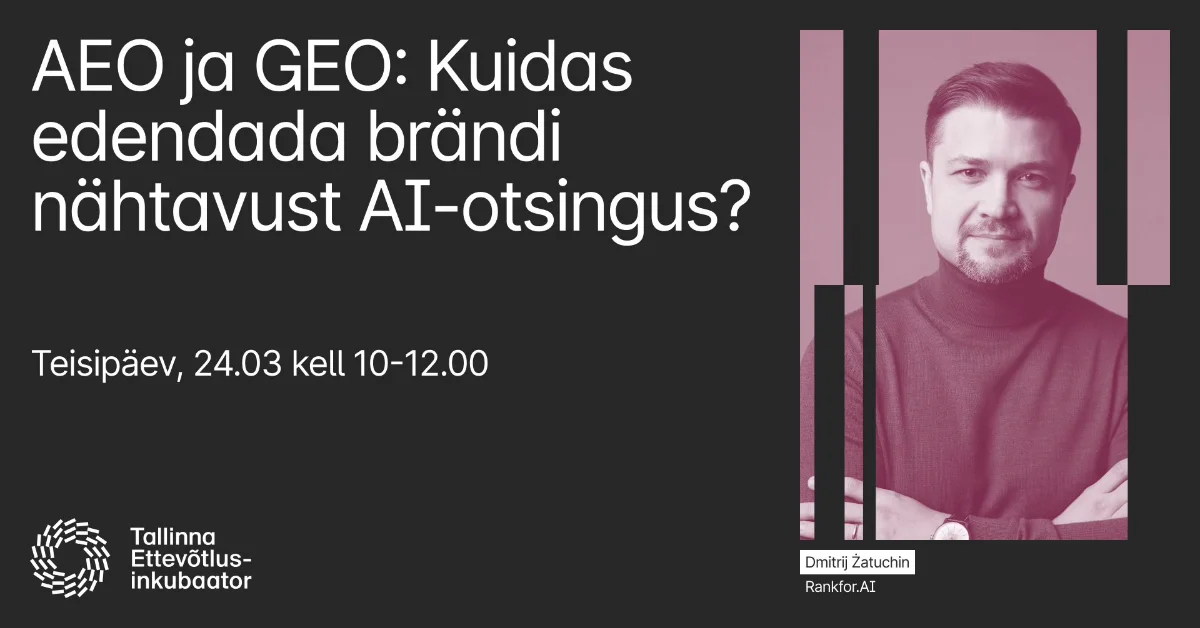
The workshop goes deeper into the four dimensions of AI visibility with live demonstrations, practical frameworks you can apply immediately, and a Q&A session. For marketing leaders and entrepreneurs building AI presence, this session provides actionable frameworks.
Registration is open now. Seats are limited.
FAQ
What is AEO (Answer Engine Optimization)?
AEO is the practice of structuring your content so that AI-powered answer engines - such as Google AI Overviews, ChatGPT, and Perplexity - can find, extract, and present your answers to user queries. It focuses on making your expertise discoverable and usable by AI systems through question-focused content, structured data, and source authority signals.
What is GEO (Generative Engine Optimization)?
GEO (Generative Engine Optimization) is the practice of optimizing digital content to be included and accurately represented in AI-generated responses. Unlike SEO which focuses on ranking in search results, GEO focuses on being synthesized into AI answers. It involves structuring content so AI models can easily understand, trust, and recommend your brand - through consistent messaging, substantiated claims, and clear differentiation.
How is GEO different from SEO?
SEO optimizes for ranking in link-based search results. GEO optimizes for inclusion and accuracy in AI-generated responses. SEO evaluates individual pages against relevance and authority signals. GEO evaluates your entire brand presence against coherence, substantiation, and distinctiveness. Both are important, but they require different strategies and different metrics. Strong SEO alone does not guarantee strong AI visibility.
How do AI models choose which brands to recommend?
AI models synthesize information from multiple sources to form a brand understanding. They evaluate consistency of messaging across sources, the quality of evidence behind claims, the depth of topical coverage, and signals of authority and trust. Brands that provide well-structured, substantiated, and consistent information across their content surfaces are more likely to be mentioned, accurately described, and confidently recommended by AI systems.
References
- Zero-click search data: SparkToro, 2024 Zero-Click Search Study
- AI Overview CTR impact: BrightEdge, 2025 AI Search Analysis
- AI visitor conversion rates: Ahrefs, 2024 AI Traffic Study; Semrush, 2024 AI Search Report
- AI Overview query prevalence: BrightEdge Generative Parser, March 2025
BeVisible Club
Get research like this before we publish it.
New AI visibility studies, ranking patterns, and source-stack data delivered to your inbox a week before they go public.
Join BeVisible ClubWant to Know How AI Sees Your Brand?
Rankfor.AI measures your brand's AI visibility across all major platforms and provides actionable recommendations.
About the Author

Executive Operations Manager
Daniel Homenko leads operations at Rankfor.AI, ensuring seamless execution of our research initiatives. With a background in project management and business operations, Daniel coordinates cross-functional teams to deliver high-quality insights and maintain operational excellence.