
Key Findings
- 70.2% of AI brand knowledge is untraceable -- the largest category by far
- GPT-5.2 sentiment 0.83 vs Gemini 0.32 for the same brands -- models tell different stories
- Only 2.8% of AI outputs are stable -- 93.8% are variable across repeated prompts
- Company-owned content (14.7%) is the #1 identifiable source of AI brand knowledge
- Listed vs private companies: statistically identical AI treatment across all metrics
Your brand has an AI reputation. The problem: it changes depending on which AI your customer uses, when they ask, and how they phrase the question. We ran the largest multi-industry study of AI reputation sourcing to date. Here is what every marketer needs to know.
Why This Study Matters
Every time a buyer asks ChatGPT, Gemini, or Perplexity about your industry, those AI platforms construct a narrative about your brand in real time. That narrative is your AI reputation. Unlike traditional media coverage, you cannot see it, trace its sources, or predict what it will say next.
We set out to answer four questions: Where does AI get its brand knowledge? How consistent is it? Does your industry change the answer? And do publicly traded companies have an advantage?
The results are uncomfortable for anyone who thinks AI visibility is a simple problem.
What We Tested
We studied 24 real companies across 8 industries: E-commerce, Healthcare Technology, Logistics, Consulting, HR Tech, Web Hosting, Marketing Technology, and FinTech. Half were publicly traded, half private. Companies ranged from Fortune 500 firms to startups.
We administered 1,296 prompts across GPT-5.2 and Gemini 3 Flash, plus 72 grounded-mode probes via Perplexity. Each stability prompt was repeated five times per brand to measure consistency. In total, we analyzed 1,311 responses and coded 3,041 source attributions by hand.
Finding 1: 70% of What AI "Knows" About Your Brand Cannot Be Traced
We classified every source attribution AI made when discussing brands. The single largest category: "Other / Unattributable" at 70.2%. AI knows things about your brand, but we cannot pinpoint where that information came from.
The sources we could trace:
| Source Type | Share of All Citations |
|---|---|
| Company-owned content | 14.7% |
| Tier-1 news media | 5.7% |
| Review platforms | 4.6% |
| Trade/sector news | 1.8% |
| Wikipedia | 1.5% |
| Financial/regulatory | 0.6% |
| Social media | 0.5% |
| 0.4% | |
| Government sources | 0.1% |
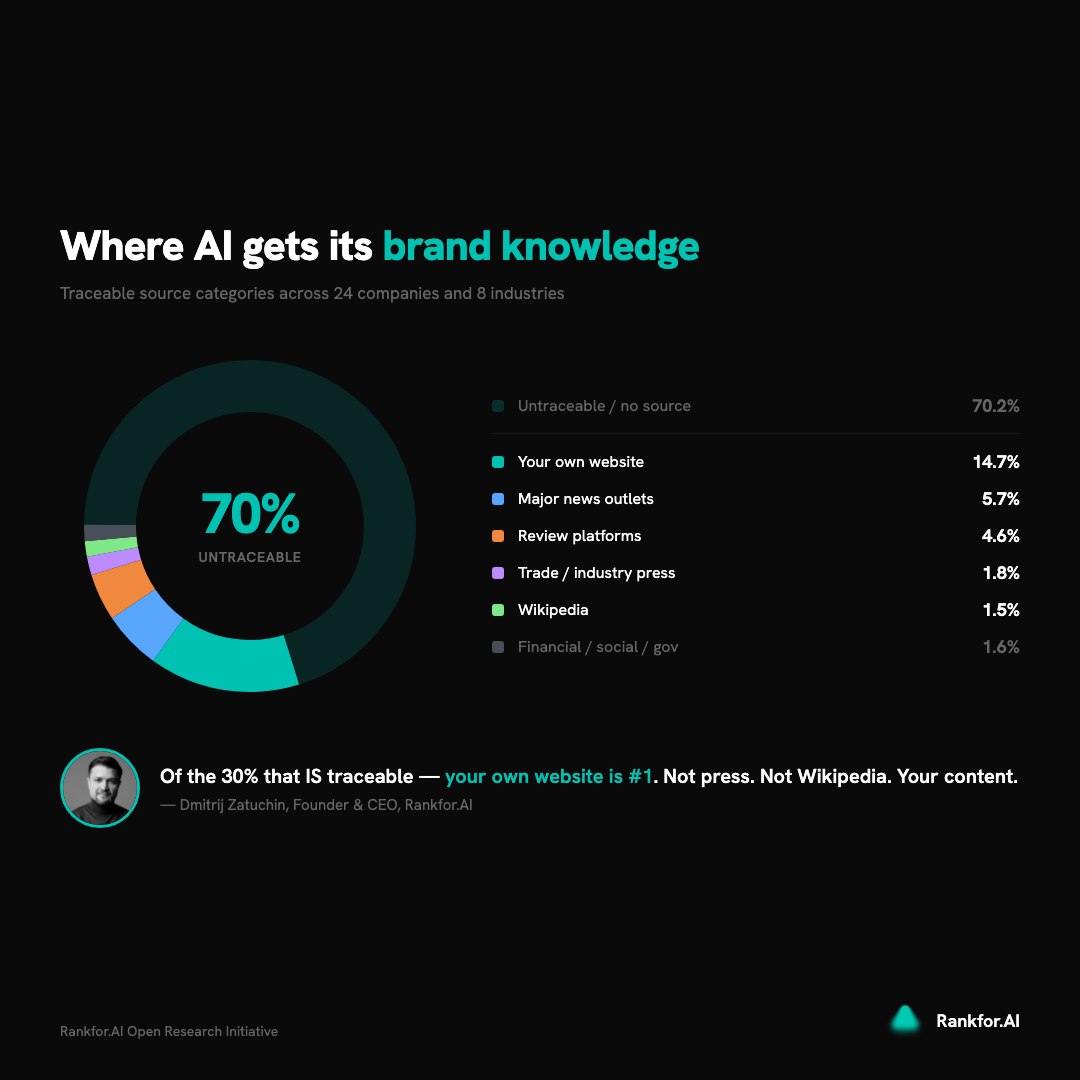
What this means for you: Your own website content is the single largest identifiable source of AI brand knowledge. Traditional PR (tier-1 media) is second. Everything else is marginal. But the 70% you cannot influence through any direct channel is the structural challenge nobody talks about.
Finding 2: AI Models Tell Completely Different Stories About Your Brand
We compared how GPT-5.2 and Gemini 3 Flash perceive the same brands. The gap is dramatic.
GPT-5.2 produced a mean sentiment score of 0.83 (on a scale from -1 to +1). That is overwhelmingly positive. In fact, 96.4% of GPT's responses about brands were positive.
Gemini 3 Flash produced a mean sentiment of 0.32. Only 51.5% of its responses were positive.
The correlation between the two models' sentiment scores? r = 0.37 -- weak and not statistically significant. The models do not just use different scales. They weight different aspects of reputation entirely.
What this means for you: If you only audit your AI presence on ChatGPT, you are seeing an artificially rosy picture. Your customers use multiple AI platforms. Each one tells a different story about you.
Finding 3: Ask the Same AI Twice and You Get Different Answers
We repeated the same prompt five times for every brand on every model. The average consistency score across all companies: 0.54 cosine similarity.
To put that in context: only 2.8% of all company-model-prompt combinations exceeded the 0.85 threshold we defined as "stable." Meanwhile, 93.8% fell below 0.70, which we classified as "variable."
GPT-5.2 was slightly more consistent (0.57) than Gemini 3 Flash (0.51), but neither model gives the same answer reliably.
What this means for you: There is no fixed "AI reputation." Every time someone asks about your brand, AI constructs a slightly different narrative. A single-prompt audit captures an approximation. You need repeated measurements to understand your actual AI presence.
Finding 4: Your Industry Determines Which Sources AI Uses
We found a statistically significant relationship between industry sector and source distribution (chi-square = 143.28, p < 0.001). The effect size is small (Cramer's V = 0.08), but the patterns are real and actionable.
Consulting firms get the richest identifiable source mix: 30.8% of their AI reputation comes from corporate content plus tier-1 news combined. McKinsey gets 8% of its traceable citations from outlets like Bloomberg and Financial Times.
Marketing Technology companies face the highest source opacity: 81.3% of their AI reputation is unattributable. If you are in B2B tech, assume most of what AI knows about you is baked into its training data with no clear origin.
HR Tech brands lean heavily on review platforms: 9.6% of identifiable sources come from G2, Capterra, and similar sites -- the highest of any sector.
What this means for you: Your AI content strategy needs to match the source patterns that AI actually uses in your industry. A consulting firm should invest in thought leadership and media relations. An HR Tech company should invest in review platform presence. A generic playbook will not work.
Finding 5: Being Publicly Traded Gives You Zero Advantage
We compared 12 listed companies against 12 private companies across every metric we measured. The results: statistically identical.
- Consistency: Listed 0.54 vs. Private 0.54 (d = 0.03, negligible)
- Sentiment: Listed 73.9% positive vs. Private 74.5% positive
- Source diversity: No significant difference (Shannon entropy: 1.43 vs. 1.37)
- Citation richness: Private companies actually received slightly more attributions per company (130.0 vs. 123.4)
- Financial/regulatory sources: Less than 1% for both groups
SEC filings, Bloomberg coverage, Crunchbase profiles - none of it gives listed companies a measurable advantage in how AI perceives them.
What this means for you: If you are a private company or a startup, you are not at a structural disadvantage. AI treats a startup the same as a Fortune 500 company. The playing field is level. The winning tactics - whether your content is structured for AI comprehension.
The Grounded Mode Exception
There is one bright spot in all of this. When AI models use retrieval-augmented generation (the mode where they actively search the web before answering), source attribution becomes transparent. We tested this with Perplexity, which provides URL-level citations.
In grounded mode, the "unattributable" category shrinks dramatically. You can see exactly which pages AI pulled from, verify accuracy, and optimize accordingly.
What this means for you: As more AI platforms adopt retrieval-augmented modes (like Google's AI Overviews or Perplexity's citations), the source opacity problem will diminish. But for now, the majority of AI conversations about brands happen in parametric mode - where 70% of knowledge has no traceable origin.
What to Do Starting Monday
The research points to three actionable priorities:
1. Audit Your AI Presence Across Multiple Models
Do not just ask ChatGPT about your brand. Ask Gemini. Ask Perplexity. With a 0.51-point sentiment gap between models and only 2.8% of outputs being stable, you need a multi-model, repeated-measurement approach to understand your actual AI reputation.
2. Invest in the Sources That Actually Matter
70% of AI knowledge is baked into training data and untraceable. Of the 30% you can influence: your own website content (14.7%) and tier-1 media coverage (5.7%) are the top two. Review platforms matter for specific industries (especially HR Tech at 9.6%). Social media and LinkedIn together account for less than 1%.
Prioritize: company-owned content first, earned media second, industry-specific sources third.
3. Build a Monitoring Habit
AI reputation is not stable. It shifts with every query, every model update, every new piece of training data. You would not check your Google rankings once and forget about it. Monthly AI visibility monitoring is the minimum. Quarterly comprehensive audits across models are the standard.
Study Details
- Sample: 24 companies, 8 industries, 12 publicly traded + 12 private
- Prompts: 1,296 administered, 1,311 analysable responses
- Models: GPT-5.2 (OpenAI), Gemini 3 Flash (Google), Perplexity (grounded mode)
- Source attributions: 3,041 coded by two independent trained coders
- Stability iterations: 5 repetitions per prompt per brand per model
- Publication: Springer Discover Artificial Intelligence (peer-reviewed)
- Data collection: 20 February 2026
The Bottom Line
AI is building a reputation for your brand whether you manage it or not. The question is whether you understand where that reputation comes from (mostly untraceable), how stable it is (not very), and how different it looks across platforms (dramatically different).
The brands that win recommendation share in the AI era will not be the ones with the biggest budgets or the longest track records. They will be the ones that understand how AI reasons about them - and structure their content accordingly.
People Also Ask
Continue Reading
Cross-Model Response Stability Analysis: A Comparative Study of Brand Mention Consistency in Large Language Models
This study investigates response variability and brand mention consistency across three leading LLMs: Google Gemini 3 Flash, OpenAI GPT-5.2, and xAI Grok-4-1. Using 239 total samples across three prompt variations (husband, wife, 2025), we measured brand mention frequency, response consistency, and cross-model agreement.
Only 1 in 6 Brands Has Strong AI Visibility: Corporate Visibility Pattern Analysis
Analysis of 195 AI queries across 6 corporate brands reveals three visibility patterns: Invisible (PGE, Polpharma), Brand-Dependent (TotalEnergies, Holcim), Topic-Locked (Orlen). Only 1 in 6 has strong AI presence.
The State of AI Visibility: Why Brands Are Losing Control Inside AI Answers
Search didn't disappear. It stopped being the place where decisions happen. Traditional SEO assumed that if you ranked well, you would be discovered. AI doesn't work that way. This thought leadership piece defines why AI visibility matters and introduces the four dimensions of AI visibility: Presence, Relevance, Usefulness, and Trust.
Understanding AI Visibility Classification: The 8 States That Define How AI Sees Your Brand
Your brand is not just "visible" or "invisible" to AI. There are 8 distinct states - from Invisible to Category Leader - and each one requires a different strategy. This article explains the classification system behind the AI Visibility Score and how metric patterns determine your strategic diagnosis.
The "Best Of" Trap: Why Self-Promotional Listicles Are Losing Google and Winning ChatGPT
Three signals in one week: Google penalized self-promotional listicles (SaaS brands losing 34-49% visibility), reduced crawl limits by 86.7%, while Ahrefs found 44% of ChatGPT citations come from those exact listicles. Google is shrinking, AI is expanding. Includes a 5-minute brand audit playbook and split strategy for navigating both discovery systems.
Four-Prompt Gender Bias Analysis: Isolating Gender Effects in LLM Brand Recommendations
This study extends cross-prompt LLM brand consistency analysis by introducing a gender-neutral "partner" prompt to isolate gender bias effects. Comparing four prompt variations across 299 total samples, we provide strong evidence of gender-based brand recommendation bias in LLMs. Critical finding: Kindle appeared in 100% of wife AND partner iterations but 0% of husband iterations.
BeVisible Club
Get research like this before we publish it.
New AI visibility studies, ranking patterns, and source-stack data delivered to your inbox a week before they go public.
Join BeVisible ClubWant to Know How AI Sees Your Brand?
Rankfor.AI measures your brand's AI visibility across all major platforms and provides actionable recommendations.
About the Author

Founder
Dmitrij Żatuchin is the founder of Rankfor.AI. A computer scientist with a PhD in semantic web technologies, he bridges the gap between how AI reasons about brands and how brands want to be understood. With over two decades of software architecture experience and academic roles at Estonian Business School, Dmitrij builds the measurement infrastructure brands need to transition from optimizing for search engines to becoming visible for reasoning engines.