
Key Findings
- ChatGPT searched the web in 897 of 900 answers to buyer questions asked in Estonian, Finnish, Latvian, Lithuanian and Polish (gpt-6-luna, the ChatGPT Free and Go default, 17 November 2026)
- Asked in Latvian, ChatGPT ran 30.8% of its topical searches in English (160 of 519). Asked in Polish or Finnish, it ran 17.2% in English (104 of 603 and 90 of 523)
- Almost half of ChatGPT's searches checked one named site: 2,810 of 5,737. The most-checked sites were regulators and public bodies such as gov.pl (66 checks) and kkv.fi (57)
- Gemini 3.8 Flash, with Google Search switched on, searched in 277 of 900 answers. When it searched, 592 of its 604 labelled searches were in the language of the question
- Public bodies were read in 814 of 900 ChatGPT answers and reddit.com in 726 of 900. A local news site from the buyer's own country was read in 212 of 900
We asked ChatGPT and Gemini 60 buyer questions in Estonian, Finnish, Latvian, Lithuanian and Polish. We kept all 6,366 searches they ran and counted the websites each answer read.
A buyer in Riga asks ChatGPT, in Latvian, which car dealerships in Riga have the best reputation for customer service. What is the answer built on? On 17 November 2026 we put that question and 59 others to two AI engines in five languages. We recorded every search and every website each answer read.
Method
- Questions: 60 buyer questions in 10 categories, from cars and clinics to B2B IT. We translated them into Estonian, Finnish, Latvian, Lithuanian and Polish.
- Engines: OpenAI gpt-6-luna with web search on. It has been the default for ChatGPT Free and Go since 8 October 2026. Google gemini-3.8-flash with Google Search grounding on. We ran both through their APIs.
- Search location: each market's capital: Tallinn, Helsinki, Riga, Vilnius and Warsaw.
- Size: 60 questions x 5 languages x 2 engines x 3 repeats = 1,800 answers, 180 per engine and market.
- Date: 17 November 2026, 19:36 to 20:32 UTC.
- Searches: 6,366 in total. A query limited to one named site (
site:gov.pl) counts as a site check. Every other query counts as a topical search, and we labelled its language where the detector was confident.- Sources: an answer "reads" a domain when the domain is in its source list. A read does not mean the answer quoted or named that source.
- Limits: these are API runs from one day, with the capital as search location. The ChatGPT and Gemini apps may behave differently. This study measures the sources the answers read. It does not show that appearing in a source leads to a mention in the answer.
ChatGPT searches, mostly in the buyer's language
ChatGPT (gpt-6-luna, 17 November 2026) searched the web in 897 of 900 answers. It ran 5,737 searches, a median of 6 per answer.
2,927 of those searches were topical. 2,143 were in the language of the question and 650 were in English. That is 23.3% English among the 2,795 topical searches we could label.
| Market | English share of labelled topical searches | Answers with at least one English topical search (of 180) |
|---|---|---|
| Latvia | 30.8% (160 of 519) | 60 |
| Lithuania | 26.9% (153 of 569) | 57 |
| Estonia | 24.6% (143 of 581) | 55 |
| Finland | 17.2% (90 of 523) | 38 |
| Poland | 17.2% (104 of 603) | 28 |
| All five | 23.3% (650 of 2,795) | 238 of 900 |
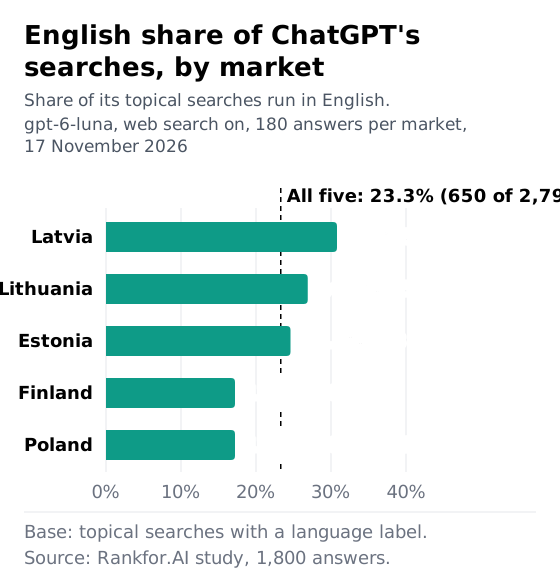
Chart 1. How much of ChatGPT's searching happens in English, by market. ChatGPT (gpt-6-luna, the ChatGPT Free and Go default) with web search on, 180 answers per market, 17 November 2026. Base for the share: topical searches with a language label.
ChatGPT ran English searches most often in Latvia and Lithuania. English pages about a company in these markets can be part of what an answer is built from.
Almost half of ChatGPT's searches check one named site
2,810 of ChatGPT's 5,737 searches (49.0%) were site checks (gpt-6-luna, 17 November 2026). The sites it checked most often were public bodies and regulators:
- gov.pl: 66 of 2,810 checks
- kkv.fi: 57
- europa.eu: 37
- ptac.gov.lv: 35
- ttja.ee: 34
These checks find a company's own pages and the regulator's pages in the local language.
Gemini often answers without searching
Gemini (gemini-3.8-flash with Google Search grounding on, 17 November 2026) searched in 277 of 900 answers. The model wrote the other 623 answers with no search and no sources.
When Gemini did search, it used the buyer's language: 592 of its 604 labelled searches were in the language of the question. It ran no site checks (0 of its 629 searches).
ChatGPT read a median of 16 to 18 websites per answer (180 answers per market). Gemini read a median of 7 to 8 in the answers where it searched.
Local news is one source among several
Here, local media means a news, magazine or trade site from the buyer's own country, which we checked by hand. Press release services and press rooms do not count.
ChatGPT (gpt-6-luna, 17 November 2026) read a same-country news site in 212 to 250 of 900 answers. The lower figure leaves out 39 borderline sites. Neither figure counts the Äripäev print archive. Four other source types were read more often:
| Source type | ChatGPT answers that read at least one (of 900) |
|---|---|
| Public body | 814 |
| Global platform | 747 |
| Local business site | 711 |
| Directory or review site | 579 |
| Local media | 212 to 250 |
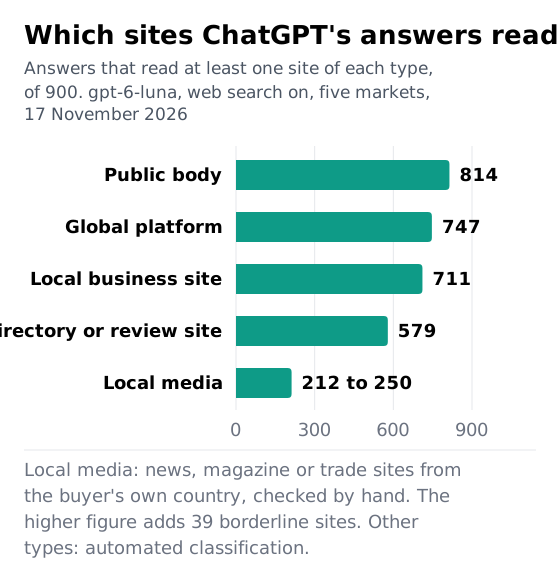
Chart 2. Source types in ChatGPT answers. gpt-6-luna with web search on, 900 answers across five markets, 17 November 2026. We corrected the local media figures by hand. The other source types come from automated classification.
The single domain ChatGPT read most was reddit.com, in 726 of 900 answers.
Poland was the strongest market for local media in this sample. 72 of 180 Polish ChatGPT answers read at least one Polish news or trade media site, or 87 if the borderline sites count. The host read most often, bankier.pl, appeared in 17 of the 180. In Estonia, 46 of 180 ChatGPT answers read PDF print issues from the Äripäev archive. A sample of 3 of those PDFs dated from 2008, 2009 and 2014, so we left the archive out of the local media figures. Apart from that archive, no single news host reached 20 of 180 ChatGPT answers in any market.
Gemini has a smaller base. 59 to 72 of the 277 answers in which it searched read local media (gemini-3.8-flash, 17 November 2026). Gemini read three source types more often: local business sites (265 of 277), directory or review sites (170 of 277) and public bodies (80 of 277).
What a company in these markets can do
All figures below come from the 17 November 2026 runs. ChatGPT figures are out of 900 answers unless a market base is given.
- Answer buyer questions on your own site, in the local language. ChatGPT ran 2,143 of its 2,927 topical searches in the question's language. Gemini ran 592 of its 604 labelled searches in that language. Say plainly who you serve, where, at what price and with which licences.
- Keep an English version up to date if you sell in Latvia, Lithuania or Estonia. In each of those markets, ChatGPT ran at least one English search in 55 to 60 of 180 answers.
- Check what regulators and public registers say about you. ChatGPT read public bodies in 814 of 900 answers. If a licence or listing is out of date, ask the authority to correct it.
- Review your directory and review site profiles. ChatGPT read these sites in 579 of 900 answers. Gemini read them in 170 of the 277 answers in which it searched.
- Read the forum threads about your category. ChatGPT read reddit.com in 726 of 900 answers. Know what those threads say, and take part openly where your team has real experience.
- Plan for local press as one channel among several. In Poland, 72 to 87 of 180 ChatGPT answers read a Polish news or trade site.
- Measure your own questions. Put your buyers' questions to the engines and count which sources and which companies come back. Appearing in a source does not guarantee a mention.
Check your own access
First, check whether AI engines can reach your website at all. The AI access check is free: https://open.rankfor.ai/. To go through the results or plan a study of your own buyer questions, book 20 minutes with Dmitrij: https://meetings-eu1.hubspot.com/dmitrij/rankfor.
Continue Reading
Where AI Gets Its Answers: 167,551 Citations Behind Brand Reputation
A cross-market citation dataset: 167,551 URL-grounded citations across 128 brands, 13 languages, and 12 markets from GPT, Gemini, and Perplexity. AI grounds brand answers in third-party sources 85.7% of the time; 18% of domains carry 80% of citations; Wikipedia is the top domain in 11 of 12 languages. Open under CC-BY-4.0 with DOI.
Gemini 3.5 Flash: Google’s Great Grounding Leap and What It Means for CMOs
A full-scale replication study analyzing 1,239 grounding citations from Google’s newly released Gemini 3.5 Flash across the 66-brand Nordic-Baltic-CEE Index. We map how Google has closed the citation gap.
How to Know If AI Recommends Your Brand (and How to Fix It)
Ask AI the questions your buyers ask, see if your brand appears, and read the sources it cites. Free with Answer Trail, GDPR aligned. The fix: about 85% of what AI cites sits off your own website, so earn roughly five credible third-party mentions per buyer question to reach about 80% presence, then watch it over time because the cited sources turn over week to week.
PR Guide for AI Validation in Northern Europe
Tier-1 publishers dictate brand visibility in AI systems. We mapped the geographic dependencies of AI validation in Northern Europe, proving that cross-border business journalism drives model grounding far more than local press releases.
BeVisible Club
Get research like this before we publish it.
New AI visibility studies, ranking patterns, and source-stack data delivered to your inbox a week before they go public.
Join BeVisible ClubWant to Know How AI Sees Your Brand?
Rankfor.AI measures your brand's AI visibility across all major platforms and provides actionable recommendations.
About the Author

Founder & Researcher
Dmitrij Żatuchin is the founder of Rankfor.AI. A computer scientist with a PhD in semantic web technologies, he bridges the gap between how AI reasons about brands and how brands want to be understood. With over two decades of software architecture experience and academic roles at Estonian Business School, Dmitrij builds the measurement infrastructure brands need to transition from optimizing for search engines to becoming visible for reasoning engines.